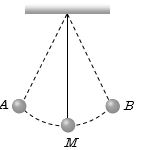
What is the velocity of the bob of a simple pendulum at its mean position, if it is able to rise to vertical height of $10\,cm$ ($g = 9.8\, m/s^2$) ..... $m/s$
Easy
Download our app for free and get started
(c) According to the principle of conservation of energy, $\frac{1}{2}m{v^2} = mgh$ or $v = \sqrt {2gh} = \sqrt {2 \times 9.8 \times 0.1} $ $ = 1.4\,m/s.$

Download our appand get started for free
Experience the future of education. Simply download our apps or reach out to us for more information. Let's shape the future of learning together!No signup needed.*
Similar Questions
- 1The maximum acceleration of a particle in $SHM$ is made two times keeping the maximum speed to be constant. It is possible whenView Solution
- 2A bead of mass $m$ is attached to the mid-point of a tant, weightless string of length $l$ and placed on a frictionless horizontal table.Under a small transverse displacement $x$, as shown in above figure. If the tension in the string is $T$, then the frequency of oscillation isView Solution
- 3The displacement of a particle executing SHM is given by $x=10 \sin \left(\omega t+\frac{\pi}{3}\right) \mathrm{m}$. The time period of motion is $3.14 \mathrm{~s}$. The velocity of the particle at $\mathrm{t}=0$is_________. $\mathrm{m} / \mathrm{s}$.View Solution
- 4Two simple harmonic motions are represented by the equations ${y_1} = 0.1\sin \left( {100\pi t + \frac{\pi }{3}} \right)$ and ${y_2} = 0.1\cos \pi t.$ The phase difference of the velocity of particle $1$ with respect to the velocity of particle $2$ isView Solution
- 5A particle of mass $0.50 \mathrm{~kg}$ executes simple harmonic motion under force $\mathrm{F}=-50\left(\mathrm{Nm}^{-1}\right) \mathrm{x}$. The time period of oscillation is $\frac{x}{35} s$. The value of $x$ is . . . . .(Given $\pi=\frac{22}{7}$ )View Solution
- 6A particle is executing simple harmonic motion with an amplitude of $0.02$ metre and frequency $50\, Hz$. The maximum acceleration of the particle isView Solution
- 7View SolutionThe phase difference between the instantaneous velocity and acceleration of a particle executing simple harmonic motion is
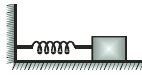
- 8Spring of spring constant $1200\, Nm^{-1}$ is mounted on a smooth frictionless surface and attached to a block of mass $3\, kg$. Block is pulled $2\, cm$ to the right and released. The angular frequency of oscillation is .... $ rad/sec$View Solution
- 9View SolutionTo show that a simple pendulum executes simple harmonic motion, it is necessary to assume that
- 10View SolutionIn simple harmonic motion, the ratio of acceleration of the particle to its displacement at any time is a measure of