Question
What is torque? Write its formula in vector form. Handle, to open the door, is always provided at the free edge of a door. Why?

Answer

Torque is the moment of force. It is written as the cross –product of the position vector of the point of application of the force and the force, i.e.,
$\vec{\tau}=\vec{\text{r}}\times\vec{\text{F}}$
It is measured in Nm and has dimensions of ML2T2. Since, $\tau=\text{rF}\sin\theta,$
where $\theta$ is the angle between $\vec{\text{r}}\text{ and }\vec{\text{F}},$ it is also said, torque is the product of the perpendicular distance between the axis of rotation and point of application of force in line with the force. It is the cause of rotational motion. To open the door, handle is to be rotated. So we need a torque. With less force one can exert more torque if the handle is at the edge.

Need a full question paper?

Generate a complete, print-ready paper with questions like this in minutes — across 16+ boards, with answer keys.
Start Generating Free

Similar questions

Equal masses of monoatomic and diatomic gases are supplied heat at the same temperature, pressure and volume. If same amount of heat is supplied to both the gases, which of them will undergo greater temperature rise?
An extended object is placed at a distance of 5.0cm from a convex lens of focal length 8.0cm.
  1. Draw the ray diagram (to the scale) to locate the image and from this, measure the distance of the image from the lens.
  2. Find the position of the image from the lens formula and see how close the drawing is to the correct result.
When 100 atm pressure is applied on a sphere in the normal and uniform direction its volume decreases by 0.01%. Calculate the Bulk's Modulus of elasticity of this material.
The battery discussed in the previous question is suddenly disconnected. Is a current induced in the other loop? If yes, when does it start and when does it end? Do the loops attract each other or repel?
The linewidth of a bright fringe is sometimes defined as the separation between the points on the two sides of the central line where the intensity falls to half the maximum. Find the linewidth of a bright fringe in a Young's double slit experiment in terms of $\lambda$, d and D where the symbols have their usual meanings.
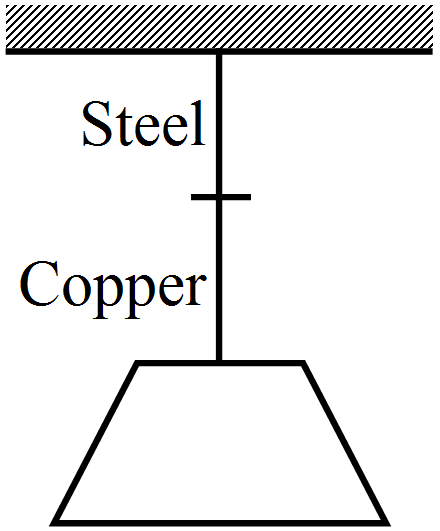
In the upper wire is made of steel and the lower of copper. The wires have equal cross-section. Find the ratio of the longitudinal strains developed in the two wires.

Does the concentration of the earth's mass near its centre change the variation of g with height compared with a homogeneous sphere, how?
A hollow spherical body of inner and outer radii 6cm and 8cm respectively floats half submerged in water. Find the density of the material of the sphere.
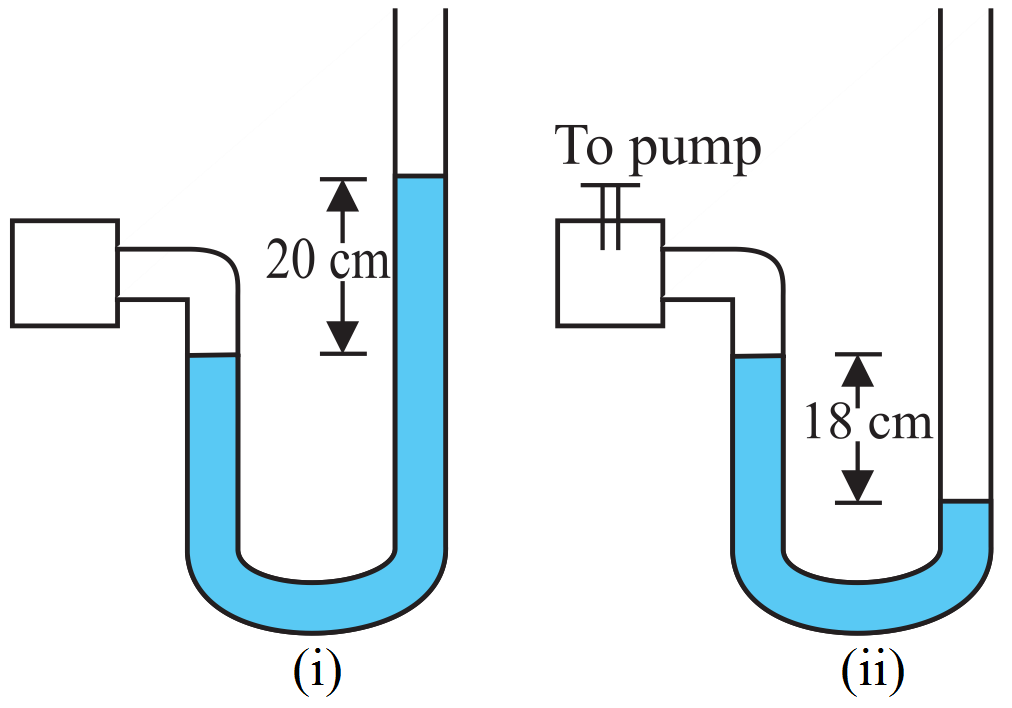
A manometer reads the pressure of a gas in an enclosure as shown in Fig.(a) When a pump removes some of the gas, the manometer reads as in Fig. (b) The liquid used in the manometers is mercury and the atmospheric pressure is 76cm of mercury.
Give the absolute and gauge pressure of the gas in the enclosure for cases (i) and (ii) in units of cm of mercury.
How would the levels change in case (i) if 13.6cm of water (immiscible with mercury) are poured into the right limb of the manometer? (Ignore the small change in volume of the gas.)

A tuning fork produces 4 beats per second with another tuning fork of frequency 256Hz. The first one is now loaded with a little wax and the beat frequency is found to increase to 6 per second. What was the original frequency of the tuning fork?