Question
  1. What is total internal reflection? Under what conditions does it occur?
  2. Find a relation between critical angle and refractive index.
  3. Name one phenomenon which is based on total internal reflection.

Answer

  1. When a ray of light travels from a denser medium into a rarer medium at an angle greater than the critical angle, it reflects back into the denser medium. This phenomenon is called total internal reflection. Conditions for total internal reflection.
    1. Light should travel from denser medium to rarer medium.
    2. Angle of incidence should be greater than critical angle.
  2. $\frac{1}{\mu} = \frac{\sin\text{ i}}{\sin\text{ r}} , $ for total internal reflection to occur $i \geq i _{c}$ at critical angle, angle of refraction$\text{?}=90^{o}$, hence, $\frac{1}{\mu} = \frac{\sin\text{i}_{c}}{\sin90^{o}}$
$\Rightarrow\mu = \frac{1}{\sin\text{i}_{c}}$
  1. Mirage/sparkling of diamond/ optical fiber/totally reflecting Prism/shinning of air bubbles in water.

Need a full question paper?

Generate a complete, print-ready paper with questions like this in minutes — across 16+ boards, with answer keys.
Start Generating Free

Similar questions

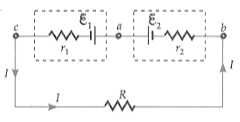
In Figure, $\varepsilon_1$ and $\varepsilon_2$ are respectively 2.0 V and 4.0 V and the resistances $r _1, r _2$ and R are respectively $1.0 \Omega$ $2.0 \Omega$ and $5.0 \Omega$. Calculate the current in the circuit. Also, calculate:
i. potential difference between the points b and a,
ii. potential difference between a and c.
Image
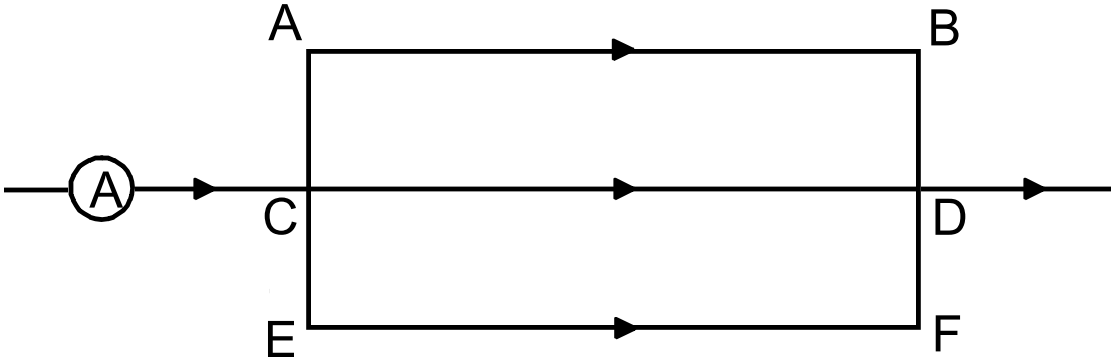
Figure shows a part of an electric circuit. The wires $AB, CD$ and $EF$ are long and have identical resistances. The separation between the neighbouring wires is $1.0\ cm.$ The wires $AE$ and $BF$ have negligible resistance and the ammeter reads $30A.$ Calculate the magnetic force per unit length of $AB$ and $CD.$
Which constituent radiation of the electromagnetic spectrum is used:
  1. In RADAR,
  2. To photograph internal parts of a human body,
  3. For taking photographs of the sky during night and foggy conditions?
Give one reason for your answer in each case.
  1. Define self inductance. Write its $S.I. $units.
  2. Derive an expression for self inductance of a long, solenoid of length $l, $cross sectional area $A$ having $N$ number of turns.
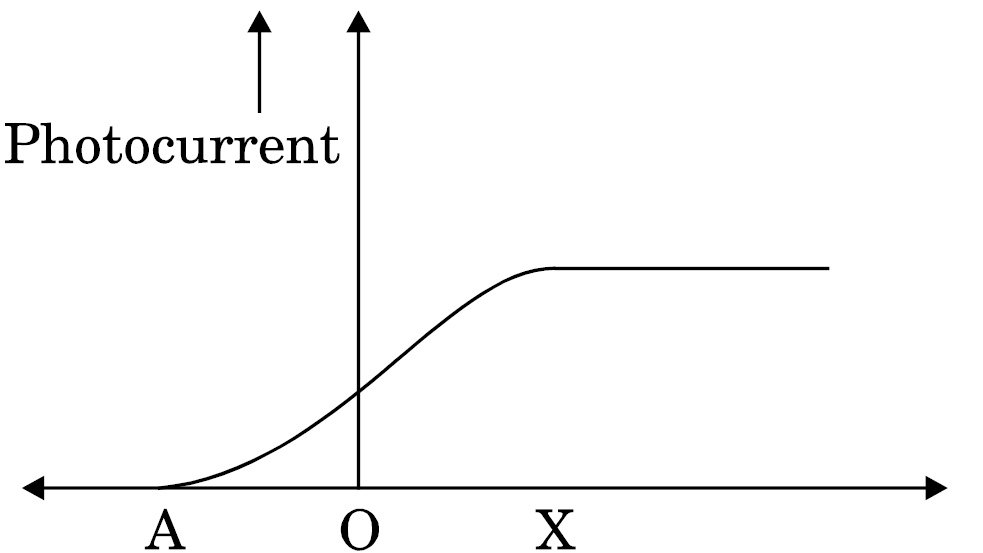
The following graph shows the variation of photocurrent for a photosensitive metal:
  1. Identify the variable $X$ on the horizontal axis.
  2. What does the point A on the horizontal axis represent?
  3. Draw this graph for three different values of frequencies of incident radiation $v_1, v_2$ and $v_3 (v_1 > v_2 > v_3)$ for same intensity.
  4. Draw this graph for three different values of intensities of incident radiation $I_{1, }I_2$, and $I_3 (I_1 > I_2 > I_3)$ having same frequency.
A convex lens of focal length 20 cm is placed coaxially with a convex mirror of radius of curvature 20 cm. The two are kept at 15 cm from each other. A point object lies 60 cm in front of the convex lens. Draw a ray diagram to show the formation of the image by the combination. Determine the nature and position of the image formed.
In order to emit the electron from the metallic surface, which physical methods are used to give the minimum energy? Explain.
What are the utilities of moderator, coolant and controlling rods with reference to nuclear reactor.
The current through a wire depends on time as $\text{i}=\text{i}_0+\alpha\text{t},$
Where $\text{i}_0=10\text{A}$ and $\alpha=4\text{A/ s}.$ Find the charge that crosses through a section of the wire in 10 seconds.
An inductor 200 mH, capacitor 500 µF, resistor 10Ω are connected in series with a100 V, variable frequency a.c. source. Calculate the
  1. Frequency at which the power factor of the circuit is unity.
  2. Current amplitude at this frequency.
  3. Q-factor.