Question
  1. What is total internal reflection? Under what conditions does it occur?
  2. Find a relation between critical angle and refractive index.
  3. Name one phenomenon which is based on total internal reflection.

Answer

  1. When a ray of light travels from a denser medium into a rarer medium at an angle greater than the critical angle, it reflects back into the denser medium. This phenomenon is called total internal reflection. Conditions for total internal reflection.
    1. Light should travel from denser medium to rarer medium.
    2. Angle of incidence should be greater than critical angle.
  2. $\frac{1}{\mu} = \frac{\sin\text{ i}}{\sin\text{ r}} , $ for total internal reflection to occur $i \geq i _{c}$ at critical angle, angle of refraction$\text{?}=90^{o}$, hence, $\frac{1}{\mu} = \frac{\sin\text{i}_{c}}{\sin90^{o}}$
$\Rightarrow\mu = \frac{1}{\sin\text{i}_{c}}$
  1. Mirage/sparkling of diamond/ optical fiber/totally reflecting Prism/shinning of air bubbles in water.

Need a full question paper?

Generate a complete, print-ready paper with questions like this in minutes — across 16+ boards, with answer keys.
Start Generating Free

Similar questions

Write the mathematical relation for the resistivity of a material in terms of relaxation time, number density and mass and charge of charge carriers in it. Explain, using this relation, why the resistivity of a metal increases and that of a semi-conductor decreases with rise in temperature.
A current-carrying circular coil of 100 turns and radius 5.0cm produces a magnetic field of $6.0 \times 10^{-5}T$ at its centre. Find the value of the current.
A free atom of iron emits $\text{K}_\alpha$ X-rays of energy 6.4keV. Calculate the recoil kinetic energy of the atom. Mass of an iron atom $= 9.3 \times 10^{-26}kg.$
We have valence electrons and conduction electrons in a semiconductor. Do we also have 'valence holes' and 'conduction holes'?
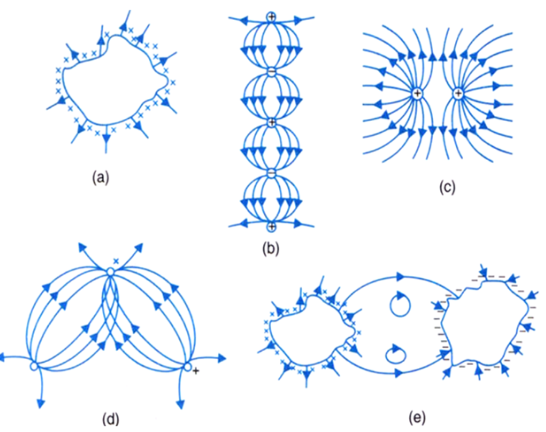
Which among the curves shown in Fig. 1.35 cannot possibly represent electrostatic field lines?
Define the term self-inductance. Write its SI unit. Give two factors on which self inductance of an air-core coil depends.
  1. Show using a proper diagram how unpolarised light can be linearly polarised by reflection from a transparent glass surface.
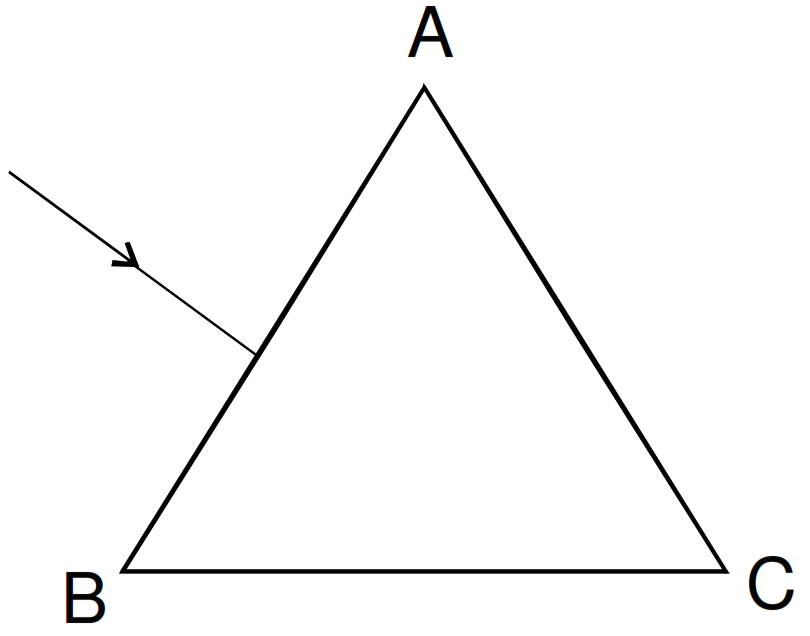
  2. The figure shows a ray of light falling normally on the face AB of an equilateral glass prism having refractive index $\frac{3}{2},$ placed in water of refractive index $\frac{4}{3}.$ Will this ray suffer total internal reflection on striking the face AC? Justify your answer.
A nearsighted person cannot see beyond 25cm. Assuming that the separation of them glass from the eye is 1cm, find the power of lens needed to see distant objects.
The average separation between the proton and the electron in a hydrogen atom in ground state is $5.3 \times 10^{-11} m.$
  1. Calculate the Coulomb force between them at this separation.
  2. When the atom goes into its first excited state the average separation between the proton and the electron increases to four times its value in the ground state.What is the Coulomb force in this state?
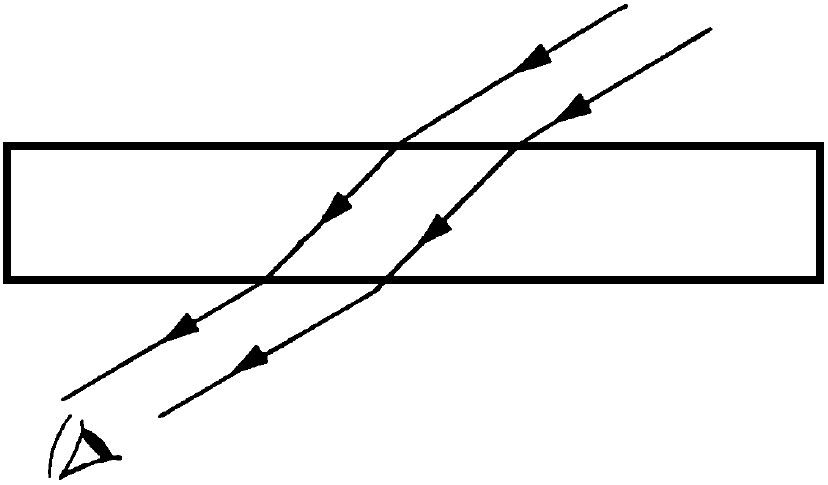
A narrow beam of light passes through a slab obliquely and is then received by an eye. The index of refraction of the material in the slab fluctuates slowly with time. How will it appear to the eye? The twinkling of stars has a similar explanation.