Question
What is transgenic animals? How it is useful for man kind?

Answer

→ Animals that have had their DNA manipulated to possess and express an extra (foreign) gene are known as transgenic animals.
→ Transgenic rats, rabbits, pigs, sheep, cows and fish have been produced, although over 95 per cent of all existing transgenic animals are mice.
(i) Normal physiology and development :
→ Transgenic animals can be specifically designed to allow the study of how genes are regulated, and how they affect the normal functions of the body and its development,
→ e.g., study of complex factors involved in growth such as insulin-like growth factor. By introducing genes from other species that alter the formation of this factor and studying the biological effects that result, information is obtained about the biological role of the factor in the body.
(ii) Study of disease :
→ Many transgenic animals are designed to increase our understanding of how genes contribute to the development of disease.
→ These are specially made to serve as models for human diseases so that investigation of new treatments for diseases is made possible.
→ Today transgenic models exist for many human diseases such as cancer cystic fibrosis. rheumatoid arthritis and Alzheimer's.
(iii) Biological products :
→ Medicines required to treat certain human diseases can contain biological products but such products are often expensive to make.
→ Transgenic animals that produce useful biological products can be created by the introduction of the portion of DNA (of genes) which codes for a particular product.
Examples :
→ human protein ($\alpha$ -1-antitrypsin) used to treat emphysema.
→ Similar attempts are being made for treatment of phenylketonuria (PKU) and cystic fibrosis.
→ In 1997, the first transgenic cow, Rosie, produced human protein-enriched milk (2.4 grams per litre). The milk contained the human a lactalbumin and was nutritionally a more balanced product for human babies than natural cow-milk.
(iv) Vaccine safety :
→ Transgenic mice are being developed for use intesting the safety of vaccines before they are used on humans.
→ Transgenic mice are being used to test the safety of the polio vaccine.
If successful and found to be reliable, they could replace the use of monkeys to test the safety of batches of the vaccine.
(v) Chemical safety testing :
→ This is known as toxicity/safety testing.
→ The procedure is the same as that used for testing toxicity of drugs.
→ Transgenic animals are made that carry genes which make them more sensitive to toxic substances than non-transgenic animals.
→ They are then exposed to the toxic substances and the effects studied.
→ Toxicity testing in such animals will allow us to obtain results in less time.

Need a full question paper?

Generate a complete, print-ready paper with questions like this in minutes — across 16+ boards, with answer keys.

Start Generating Free

Similar questions

Explain pBR322 with its cloning sites, enzymes with well labeled diagram.###Explain: cloning sites. (Diagram is not necessary)
Explain Mutualism as a population interaction with suitable examples.###Explain Mutualism with examples
Read the following text carefully and answer the questions that follow:
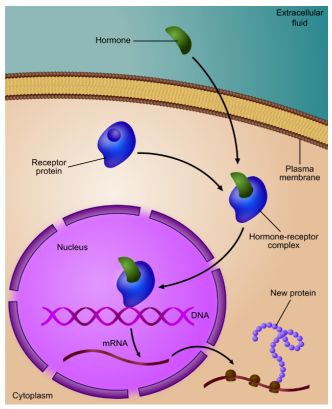
Gene regulation is the mechanism of switching off and switching on of the genes depending upon the requirement of cells and the state of development. Gene regulation is of two types: negative and positive. In negative gene regulation, the genes continue expressing their effect till their activity is suppressed. Positive gene regulation is the one in which the genes remain non-expressed unless and until they are induced to do it. Operon model is a co-ordinated group of genes such as structural gene, operator gene, promoter gene, regulator gene which function together and regulate a metabolic pathway as a unit, e.g., lac operon, trp operon, ara operon, etc.
Image
i. Regulation of gene expression occurs at which the level? (1)
ii. What is complementary to an mRNA molecule transcribed from the lac operon contains nucleotide sequences? (1)
iii. Describes the control of transcription of the genes involved in the breakdown of lactose in Escherichia coli?
(2)
OR
What is the function of catabolic activator protein in lac operon? (2)
Read the following and answer any four questions from (i) to (v) given below:
Population is defined as the total number of individuals of a species present in a particular area at a given time. 'The scientific study of human population is called demography. The rapid increase in population over a relatively short period is called population explosion. Four basic processes are involved in increase or decrease in the population size. Population shows two types of growth; exponential and logistic.
  1. Which of the following factors are responsible for population explosion?
  1. Decrease in number of people of reproducible age.
  2. Decline in infant mortality rate.
  3. Increase in maternal mortality rate.
  4. Rapid decline in death rate.
  1. A and B
  2. B and C
  3. B and D
  4. A and D
  1. What is the shape of curve showing logistic growth?
  1. Sigmoid.
  2. J-shape.
  3. Linear.
  4. Hyperbola.
  1. What is immigration?
  1. Number of individuals of the population who left the habitat.
  2. Number of individuals that have come into the habitat.
  3. Number of individuals of a species per unit area at given time.
  4. Number of births per 1000 individuals.
  1. Equation of Verhulst-Pearl logistic growth is:
  1. $\frac{\text{dN}}{\text{dt}}=\text{rN}$
  2. $\frac{\text{dN}}{\text{dt}}=\frac{\text{K-N}}{\text{k}}$
  3. $\frac{\text{dN}}{\text{dt}}=\text{rN}\Big(\frac{\text{K-N}}{\text{k}}\Big)$
  4. $\frac{\text{dN}}{\text{dt}}=\text{rN}\Big(1-\frac{\text{K-N}}{\text{k}}\Big)\text{r}$
  1. Which of the following contributes to decrease in population?
  1. Fertility.
  2. Natality.
  3. Social mobility.
  4. Emigration.
Read the following and answer any four questions from (i) to (v) given below:

ln many species of fig trees, there is a tight one-to-one relationship with the pollinator species of wasp. It means that a given fig species can be pollinated only by its 'partner' wasp species and no other species. The wasp pollinates the fig inflorescence while looking for suitable egg-laying sites. ln return for the favour of pollination, the fig offers the wasp some of its developing seeds as food for the developing wasp larvae.

  1. The interaction between fig trees and wasp is an example of:
  1. Mutualism
  2. Commensalism
  3. Amensalism
  4. Parasitism
  1. AD the given interactions are similar to interaction between fig trees and wasp, except.
  1. Plant and animal relation for pollination.
  2. Association of algae and fungi in lichens.
  3. Association of cattle egret and grazing cattle.
  4. Association of fungi and roots of higher plants in mycorrhiza.
  1. In which of the following interactions both partners are adversely affected?
  1. Parasitism
  2. Mutualism
  3. Competition
  4. Predation
  1. ln relationship between fig and wasp:
  1. One benefitted other harmed.
  2. Both are benefitted.
  3. One benefitted other unaffected.
  4. One inhibited, other unaffected.
  1. Assertion: Fig and wasp cannot complete their life cycle without each other.

Reason: They show mutualistic relationship.

  1. Both assertion and reason are true and reason is the correct explanation of assertion.
  2. Both assertion and reason are true but reason is not the correct explanation of assertion.
  3. Assertion is true but reason is false.
  4. Both assertion and reason are false.
Give a brief account of evolution of vertebrates.
Suggest some methods to assist infertile couples to have children.
Read the following text carefully and answer the questions that follow:
Malaria and dengue fever are major mosquito-borne public health problems in tropical countries. The authors report a malaria and dengue co-infection in an 11-year-old boy who presented with sustained fever for 10 days. The physical examination revealed a flushed face, injected conjunctivae and left submandibular lymphadenopathy. His peripheral blood smear showed few ring-form trophozoites of Plasmodium falciparum. His blood tests were positive for dengue NS-1 antigen and IgM antibody, and negative for IgG antibody. After the initiation of antimalarial treatment with artesunate and mefloquine, his clinical condition gradually improved. However, he still had low-grade fever that persisted for 6 days. Finally, he recovered well without fluid leakage, shock or severe bleeding.
i. Name the fish that help in eradication of mosquito larvae.
ii. What is the reason of symptoms of malaria?
iii. Name the body parts and host in which following events takes place in life cycle of plasmodium.
a. asexual reproduction
b. sexual reproduction.
OR
Name some vector borne diseases and their vector.
Read the following and answer any four questions from (i) to (v) given below:

In today's world, more than 25% of human population is suffering from hunger and malnutrition. Scientists have developed techniques where microbes are grown on industrial scale as a source of good protein which can be grown from waste water, animal manure and even sewage. Single cell proteins are such products. TI1e biomass or protein is extracted from pure or mixed cultures of algae, yeasts, fungi or bacteria. These are a very good source of food for human consumption.

  1. Why the name single cell protein is applied?
  1. It contains only one type of protein.
  2. It is obtained from unicellular edible microbes.
  3. It contains only one type of microorganism.
  4. All of these.
  1. Which of the following is considered under single cell protein?
  1. Algae.
  2. Fungi.
  3. Cyanobacteria.
  4. All of these.
  1. Microorganisms can be a useful food resource for increasing human population because:
  1. These are easy to harvest.
  2. These can grow in water system.
  3. They have a high rate of multiplication thus producing huge biomass.
  4. They have high level of nucleic acid.
  1. Single cell protein can be grown from:
  1. Waste water.
  2. Animal manure.
  3. Sewage.
  4. All of these.
  1. Assertion: Production of single cell protein reduces pollution.

Reason: Single cell protein can be grown from waste water and even sewage.

  1. Both assertion and reason are true and reason is the correct explanation of assertion.
  2. Both assertion and reason are true but reason is not the correct explanation of assertion.
  3. Assertion is true but reason is false.
  4. Both assertion and reason are false.
Read the following text carefully and answer the questions that follow:
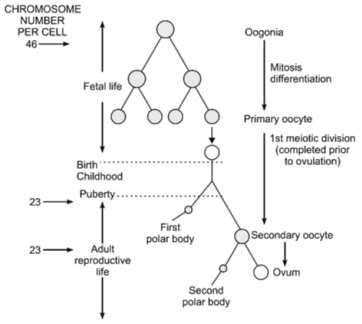
The process of formation of a mature female gamete is called oogenesis which is markedly different from spermatogenesis. A schematic representation of Oogenesis is shown below study the flow chart carefully.
Image
i. How is a primary oocyte different from a secondary oocyte? (1)
i. Mention the changes taking place during the transition of a secondary follicle to Graafian follicle in the oogonia. (1)
iii. How many primary follicles are left in each ovary in a human female at puberty? (2)
OR
What happen to graafuan follicle after ovulation? (2)