MCQ
What is wrongly stated about electrochemical series
  • A
    It is the representation of element in order of increasing or decreasing standard electrode reductional potential
  • It does not compare the relative reactivity of metals
  • C
    It compares relative strengths of oxidising agents
  • D
    ${H_2}$ is centrally placed element

Answer

Correct option: B.
It does not compare the relative reactivity of metals
b
(b)Electrochemical series compare the relative reactivity of metals.

Need a full question paper?

Generate a complete, print-ready paper with questions like this in minutes — across 16+ boards, with answer keys.

Start Generating Free

Similar questions

Alkaline oxidative fusion of $MnO _2$ gives “A” which on electrolytic oxidation in alkaline solution produces B. A and B respectively are:
Assertion : The radius of the first orbit of hydrogen atom is $0.529\,\mathop A\limits^o$
Reason : Radius of each circular orbit $(r_n) - 0.529\,\mathop A\limits^o  \,(n^2/Z),$ where $n = 1, 2, 3$ and $Z =$ atomic number.
What is the $pH$ of a $10^{-4}\, M\,OH^-$ solution at $330\,K$, if $K_w$ at $330\,K$ is $10^{-13.6}$ ?
$1.0\,gm$ of pure calcium carbonate was found to require $50\,ml$ of dilute $HCl$ for complete reaction. The strength of the $HCl$ solution is given by ........ $N$
The shape of $MnO^-_4$ ion and the hybridisation of $Mn$ in $MnO^-_4$ is
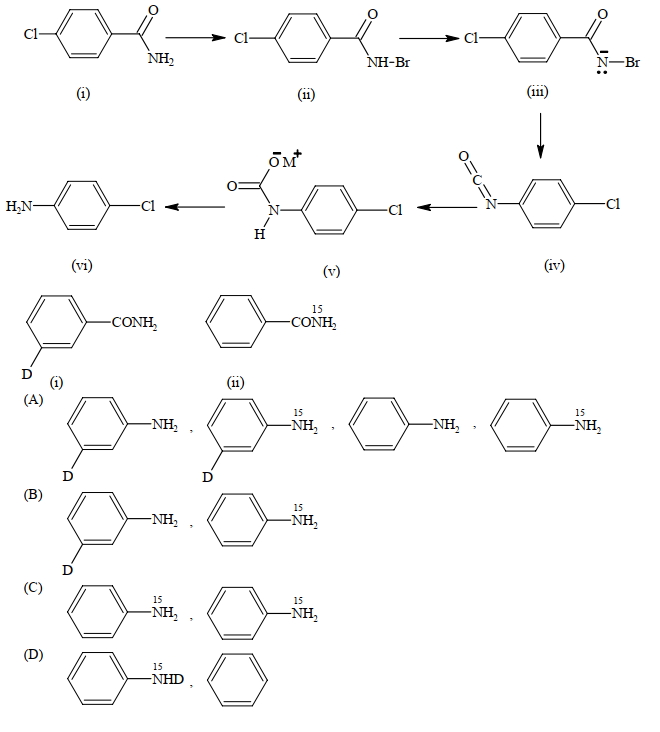
$\mathrm{RCONH}_2$ is converted into $\mathrm{RNH}_2$ by means of Hofmann bromamide degradation.

$Image$

In this reaction, $\mathrm{RCONHBr}$ is formed from which this reaction has derived its name. Electron donating group at phenyl activates the reaction. Hofmann degradation reaction is an intramolecular reaction.

$1.$  How can the conversion of $(i)$ to $(ii)$ be brought about?

$(A)$ $\mathrm{KBr}$  $(B)$ $\mathrm{KBr}+\mathrm{CH}_3 \mathrm{ONa}$  $(C)$ $\mathrm{KBr}+\mathrm{KOH}$  $(D)$ $\mathrm{Br}_2+\mathrm{KOH}$

$2.$  Which is the rate determining step in Hofmann bromamide degradation?

$(A)$ Formation of $(i)$  $(B)$ Formation of $(ii)$  $(C)$ Formation of $(iii)$  $(D)$ Formation of $(iv)$

$3.$  What are the constituent amines formed when the mixture of $(i)$ and $(ii)$ undergoes Hofmann bromamide degradation?

$Image$

give the answer question $1$, $2$, and $3.$
The correct order for the wavelength of absorption in the visible region is
The valency shell of calcium contains
The correct stability order of the given canonical structures is
In a reaction the ferrous $(F{e^{ + 2 }})$ iron is oxidised to ferric $(F{e^{ + 3 }})$ ion. The equivalent weight of the ion in the above reaction is equal to
