Question
What percent of:$1$ litre is $175\ ml$

Answer

We know that, $1$ lire $= 1000\ ml$
Therefore required precentage $=\frac{175\text{ml}}{1\ \text{liter}}$
$=\frac{175\text{ml}}{1000\text{ml}}\times100$
$= 17.5\%$
Hence $175\ ml$ is $17.5\ %$ of $1$ litre.

Need a full question paper?

Generate a complete, print-ready paper with questions like this in minutes — across 16+ boards, with answer keys.
Start Generating Free

Similar questions

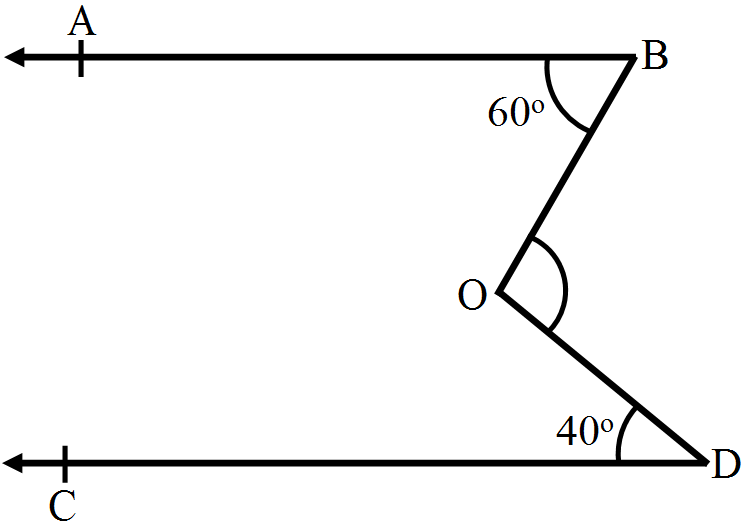
In the given figure, $\text{AB}||\text{CD},\angle\text{ABO}=60^\circ$ and $\angle\text{CDO}=40^\circ.$ Then, find $\angle\text{BOD}.$
It takes $17$ full specific type of trees to make one tonne of paper. If there are $221$ such trees in a forest, then. What fraction of forest will be used to make.
$a. 5$ tonnes of paper.
$b. 10$ tonnes of paper.
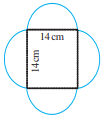
Find the perimeter of the given shape (Fig) (Take $\pi   = \frac{22}{7})$
Distinguish between a triangle and its triangular region.
The total cost of $3$ tables and $2$ chairs is $Rs. 1850$. If a table costs $Rs. 75$ more than a chair, find the price of each.
In a test, (+4) marks are given for every correct answer and (-2) marks are given for every incorrect answer:
Anil scored (-10) marks even though he had 5 correct answers. How many of his answers were incorrect? Did he leave any questions unanswered?
Triangles $ABC$ and $PQR$ are both isosceles with $AB = AC$ and $PO = PR$ respectively. If also, $AB = PQ$ and $BC = QR,$ are the two triangles congruent? Which condition do you use?It $\angle\text{B}=50^\circ,$ what is the measure of $\angle\text{R}?$
Simplify the following algebraic expressions by removing grouping symbols:
$-a - [a + {a + b - 2a - (a - 2b)} - b]$
What happens to the value of the product, when we multiply two proper fractions?
$\frac{2}{3} \times \frac{4}{5}=\frac{8}{15}$$\frac{8}{15}<\frac{2}{3}, \frac{8}{15}<\frac{4}{5}$Product is less than each of the fractions
$\frac{1}{5} \times \frac{2}{7}=$ $\square$

$\frac{3}{5} \times \frac{\square}{8}=\frac{21}{40}$

$\frac{2}{\square} \times \frac{4}{9}=\frac{8}{45}$

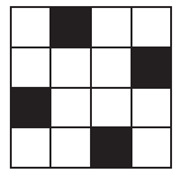
Copy the figure given here. Take any one diagonal as a line of symmetry and shade a few more squares to make the figure symmetric about a diagonal. Is there more than one way to do that? Will the figure be symmetric about both the diagonals?