Question
What sets the limits on efficiency of a heat engine?

Answer

The temperature of the cold reservoir sets the limit on the efficiency of a heat engine.
[Notes: (1) $\eta=1-\frac{T_{ C }}{T_{ H }}$
This formula shows that for maximum efficiency, $T_C$ should be as low as possible and $T_H $ should be as high as possible.
(2) For a Carnot engine, efficiency
$\left.\eta=1-\frac{T_{ C }}{T_{ H }} \cdot \eta \rightarrow 1 T _{ C } \rightarrow 0.\right]$

Need a full question paper?

Generate a complete, print-ready paper with questions like this in minutes — across 16+ boards, with answer keys.
Start Generating Free

Similar questions

Find the temperature at which
(i) the rms speed
(ii) the average kinetic energy of the molecules of an ideal gas are double their respective values at STP.
A simple pendulum is set into oscillations in a uniformly travelling car along a horizontal road. What happens to its period if the car takes a sudden turn towards the left ?
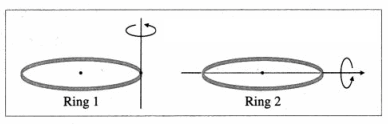
Two identical rings are to be rotated about different axes of rotation as shown by applying torques so as to produce the same angular acceleration in both. How is it possible ?

Image

Explain self induction and mutual induction.
In a biprism experiment, the slit is illuminated by red light of wavelength $6400 \mathring A$ and the cross wire of the eyepiece is adjusted at the centre of the $3^{rd}$ bright band. On using blue light, it is found that the $4^{th}$ bright band is on the cross wire. Find the wavelength of blue light.
The initial pressure, volume and temperature of a gas are respectively $1 \times 10^5 Pa , 2 \times 10^{-2} m ^3$ and $400 K$. The temperature of the gas is reduced from $400 K$ to $300 K$ at constant volume. Then the gas is compressed at constant temperature so that its volume becomes $1.5 \times 10^{-2}$ $m ^3$.
Define
(1) emissive power or radiant power
(2) coefficient of emission of a body
A gas enclosed in a cylinder fitted with a movable, massless and frictionless piston is expanded so that its volume increases from $5 L$ to $6 L$ at a constant pressure of $1.013 \times 10^5$ Pa. Find the work done by the gas in this process.
Explain the term free expansion of a gas.
Obtain an expression for the orbital magnetic moment of an electron rotating about the nucleus in an atom.