Question
What type of nature do electromagnetic waves have?

Answer

  1. Dual nature
Explanation:
Electromagnetic radiations have a wave nature as well as properties alike to those of particles. Therefore, electromagnetic radiations are emissions with a dual nature, i.e. it has both wave and particle aspects.

Need a full question paper?

Generate a complete, print-ready paper with questions like this in minutes — across 16+ boards, with answer keys.
Start Generating Free

Similar questions

If a charged particle kept at rest experiences an electromagnetic force:
  1. The electric field must not be zero.
  2. The magnetic field must not be zero.
  3. The electric field may or may not be zero.
  4. The magnetic field may or may not be zero.
When electromagnetic waves enter the ionised layer of ionosphere, then the relative permittivity i.e. dielectric constant of the ionised layer:
If a proton is projected in a direction perpendicular to a uniform magnetic field with velocity v and an electron is projected along the lines of force, what will happen to proton and electron(a) The electron will travel along a circle with constant speed and the proton will move along a straight line(b) Proton will move in a circle with constant speed and there will be no effect on the motion of electron(c) There will not be any effect on the motion of electron and proton(d) The electron and proton both will follow the path of a parabola


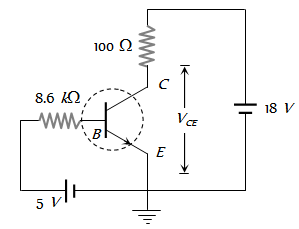
For the transistor circuit shown below, if $b = 100,$ voltage drop between emitter and base is $0.7 V$ then value of $V_{CE}$ will be
In a potentiometer of ten wires, the balance point is obtained on the sixth wire. To shift the balance point to eighth wire, we should:
The relation between electric field (E) and electric potential (V) is :
The respective radii of the two spheres of a spherical condenser are 12 cm  and 9 cm. The dielectric constant of the medium between them is 6. The capacity of the condenser will be(a) 240 pF(b) 240 μF(c) 240 F(d) None of the above
       
In semiconductors at a room temperature (a) The valence band is partially empty and the conduction band is partially filled(b) The valence band is completely filled and the conduction band is partially filled(c) The valence band is completely filled(d) The conduction band is completely empty


Who amongst the following used corpuscular theory to explain the nature of light?
The conduction current is same as displacement current when source is: