MCQ
What type of surface is the surface of a conductor?
  • Equipotential
  • B
    Unipolar
  • C
    Unipotential
  • D
    Bipolar

Answer

Correct option: A.
Equipotential

Electric field at any point is equal to the negative of the potential gradient. But inside a conductor, the electric field is zero. Hence, the electric potential is constant throughout the volume of a conductor and has the same value on its surface. Thus the surface of a conductor is equipotential.

Need a full question paper?

Generate a complete, print-ready paper with questions like this in minutes — across 16+ boards, with answer keys.
Start Generating Free

Similar questions

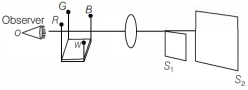
Four bulbs, red, green, white and blue (denoted by $R$ $G, W$ and $B$ respectively) are kept in front of a converging lens (as shown in the figure below). The observer sees that the green and blue bulbs are kept to the left of the principal axis, while the red and white bulbs are kept to the right of the principal axis. He also sees that the red and green bulbs are above principal axis, while the white and blue bulbs are below the principal axis. The screens $S_1$ and $S_2$ are set appropriate positions for the focusing to view the images. Choose the figure that correctly represents the images as seen by the observer.
The radius of a circular ring of wire is $R$ and it carries a current of $I\,ampere$. At its centre a smaller ring of radius $r$ with current $i$ and $N\, turns$ is placed. Assuming that the planes of two rings are perpendicular to each other and the magnetic induction produced at the centre of bigger ring is constant, then the torque acting on smaller ring will be
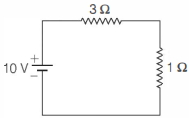
In the following circuit, $1 \,\Omega$ resistor dissipates power $P$. If the resistor is replaced by $9 \,\Omega$, the power dissipated in it is
According to Mosley's law, the frequency of a spectral line in X-ray spectrum varies as
A loop, made of straight edges has four corners at $A (L, L, O)$, $B(-L, L, O)$, $C(-L, -L, O)$, $D(L, -L, O)$. A magnetic field $\vec B = {B_0}\left( {\hat i + \hat k} \right)T$ is present in the region. The magnetic flux passing through the loop $ABCD$ is 
Polarisation of light was first successfully explained by:
Magnetic field intensity is defined as
Who discovered the first spectral series?
If critical angle for a material to air is $30^\circ$, the refractive index of the material will be
A parallel beam of light of wavelength $900\,nm$ and intensity $100\,Wm ^{-2}$ is incident on a surface perpendicular to the beam. Tire number of photons crossing $1\,cm ^{2}$ area perpendicular to the beam in one second is :