MCQ
What volume of decimolar solution should be mixed in a solution of same solute $(0.5 \,M,\,200\, ml)$ to make it $0.25\,molar$ ........ $ml$.
- ✓$333.33$
- B$500$
- C$233.33$
- D$133.33$
$0.1\, \mathrm{V}+0.5 \times 200=0.25(200+\mathrm{V})$
$\mathrm{V}=333.33\,\mathrm{ml}$
Generate a complete, print-ready paper with questions like this in minutes — across 16+ boards, with answer keys.
| gas | $Ar$ | $Ne$ | $Kr$ | $Xe$ |
| $a /\left( atm \,dm ^{6} \,mol ^{-2}\right)$ | $1.3$ | $0.2$ | $5.1$ | $4.1$ |
| $b /\left(10^{-2} \,dm ^{3}\, mol ^{-1}\right)$ | $3.2$ | $1.7$ | $1.0$ | $5.0$ |
Which gas is expected to have the highest critical temperature?

Statement I : $\left[\mathrm{Co}\left(\mathrm{NH}_3\right)_6\right]^{3+}$ is a homoleptic complex whereas $\left[\mathrm{Co}\left(\mathrm{NH}_3\right)_4 \mathrm{Cl}_2\right]^{+}$is a heteroleptic complex.
Statement II : Complex $\left[\mathrm{Co}\left(\mathrm{NH}_3\right)_6\right]^{3+}$ has only one kind of ligands but $\left[\mathrm{Co}\left(\mathrm{NH}_3\right)_4 \mathrm{Cl}_2\right]^{+}$has more than one kind of ligands.
In the light of the above statements, choose the correct answer from the options given below.
$[Figure]$ $\xrightarrow[{2.\,C{H_3}I\,(l.\,eq.)}]{{1.\,{K_2}C{O_3}}}$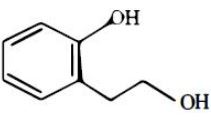
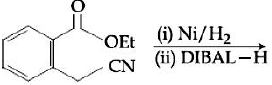
$CH_3 -C\equiv C-H$ $\xrightarrow{{C{H_3}MgBr}}$ $CH_4+(A)$ $\mathop {\xrightarrow{{(i)\,C{O_2}}}}\limits_{(ii)\,{H_2}O/{H^ \oplus }} $ $(B)$
$(B)$ will be :