Question
What was the difficulty with the wave theory ? How was this difficulty explained using Maxwell's Electro-magnetic wave theory ?

Answer

The only major difficulty with wave theory was that, since it was thought that a wave required a medium for its propagation, how could light waves propagate through vacuum.
This was explained when Maxwell put forward his famous electro magnetic theroy of light.
He had developed a set of equations describing the laws of electricity and magnetism, and using these equations he derived what is known as the wave equation, from which he predicted the existence of electro magnetic waves.
From the wave equation, he calculated the speed of Electro magnetic waves in free space and he found that the theoretical value was very close to the measured value of speed of light.
From this, he propounded that light must be an electro magnetic wave.
Thus, according to Maxwell, light waves are associated with changing electric and magnetic
fields. Changing electric field produces time and space varying magnetic field, and a changing magnetic field produces a time and space varying electric field.
The changing electric and magnetic fields result in the propogation of electromagnetic waves (or light waves) even in vacuum.
Need a full question paper?

Generate a complete, print-ready paper with questions like this in minutes — across 16+ boards, with answer keys.

Start Generating Free

Similar questions

Show that the internal energy of the air (treated as an ideal gas) contained in a room remains constant as the temperature changes between day and night. Assume that the atmospheric pressure around remains constant and the air in the room maintains this pressure by communicating with the surrounding through the windows, doors, etc.
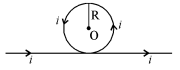
A long wire is bent as shown in the figure. Find the magnitude and direction of magnetic field at center $O$ of the circular part when a current $i$ ampere flows through it.
Image
Find the dimensions of:

  1. The specific heat capacity c.
  2. The coefficient of linear expansion a.
  3. The gas constant R.
Some of the equations involving these quantities are

$\text{Q = mc(T}_2-\text{T}_1),\text{l}_{\text{t}}=\text{l}_0[1+\alpha(\text{T}_2-\text{T}_1)]$ and $\text{PV = nRT}.$

A conducting loop of face-area A and resistance R is placed perpendicular to a magnetic field B. The loop is withdrawn completely from the field. Find the charge which flows through any cross-section of the wire in the process. Note that it is independent of the shape of the loop as well as the way it is withdrawn.
What is image? Explain its types.
State the factor, which controls (i) wavelength of light and (ii) intensity of light, emitted by a LED.
Two identical phase connected waves, each of intensity $I _0$, are producing interference patterns. Write the value of the resultant intensity at the places of (i) constructive interference, (ii) destructive interference
Can we conclude from the interference phenomenon whether light is a transverse wave or a longitudinal wave?
Suppose, in certain conditions only those transitions are allowed to hydrogen atoms in which the principal quantum number n changes by 2. (a) Find the smallest wavelength emitted by hydrogen. (b) List the wavelength emitted by hydrogen in the visible range (380nm to 780nm).
Describe Young's experiment performed to obtain coherent sources (More popularly known as Young's Double Slit Experiment) with proper figure.