MCQ
What will be the $IUPAC$ name of the given compound

$\begin{array}{*{20}{c}}
  {\,\,\,\,\,\,\,\,\,\,\,\,\,\,\,\,\,\,\,\,\,\,\,\,\,\,\,\,\,\,\,\,\,C{H_3}\,\,\,\,\,\,\,\,\,\,\,\,\,\,\,\,\,\,\,\,C{H_2} - C{H_3}} \\ 
  {\,\,\,\,\,\,\,\,\,\,\,\,\,\,\,\,|\,\,\,\,\,\,\,\,\,\,\,\,\,\,\,\,\,\,\,\,\,\,\,\,\,\,\,\,\,\,\,\,|} \\ 
  {C{H_3} - CH - CH - C{H_2} - CH - C{H_3}} \\ 
  {|\,\,\,\,\,\,\,\,\,\,\,\,\,\,\,\,\,\,\,\,\,\,\,\,\,\,\,\,\,\,\,\,\,\,\,\,\,\,\,\,\,\,\,\,\,\,\,\,} \\ 
  {C{H_2} - C{H_{3\,\,\,\,}}\,\,\,\,\,\,\,\,\,\,\,\,\,\,\,\,\,\,\,\,\,\,\,\,} 
\end{array}$

  • A
    $2, 5 -$ diethyl$ -4 -$methylexane
  • $3, 4, 6 -$trimethyloctane
  • C
    $2, 5, 6 -$ trimethyloctane
  • D
    $3, 5 -$dimethyl $-6 -$ehtylheptane

Answer

Correct option: B.
$3, 4, 6 -$trimethyloctane
b
(b) $\mathop {\begin{array}{*{20}{c}}
  {\,\,\,\,\,\,\,\,\,\,\,\,\,\,\,\,\,\,\,\,\,\,\,\,\,\,\,\,\,\,\,\,\,C{H_3}\,\,\,\,\,\,\,\,\,\,\,\,\,\,\,\,\,\,\,\,\mathop C\limits^7 {H_2} - \mathop C\limits^8 {H_3}} \\ 
  {\,\,\,\,\,\,\,\,\,\,\,\,\,\,\,\,|\,\,\,\,\,\,\,\,\,\,\,\,\,\,\,\,\,\,\,\,\,\,\,\,\,\,\,\,\,\,\,\,|} \\ 
  {C{H_3} - \mathop C\limits^3 H - \mathop C\limits^4 H - \mathop C\limits^5 {H_2} - \mathop C\limits^6 H - C{H_3}} \\ 
  {|\,\,\,\,\,\,\,\,\,\,\,\,\,\,\,\,\,\,\,\,\,\,\,\,\,\,\,\,\,\,\,\,\,\,\,\,\,\,\,\,\,\,\,\,\,\,\,\,} \\ 
  {\mathop C\limits^2 {H_2} - \mathop C\limits^1 {H_3}\,\,\,\,\,\,\,\,\,\,\,\,\,\,\,\,\,\,\,\,\,\,\,\,} 
\end{array}}\limits_{3,4,6 - Trimethyloc\tan e} $

Need a full question paper?

Generate a complete, print-ready paper with questions like this in minutes — across 16+ boards, with answer keys.

Start Generating Free

Similar questions

Which of the following do not contain an acyl group
The Gibb's energy for the decomposition of $Al_2O_3$ at $500^oC$ is as follows

$\frac{2}{3} Al_2 O_3 \rightarrow \frac{4}{3} Al + O_2$

$\Delta _rG = + 960\, kJ\, mol^{-1}$

The potential difference needed for the electrolytic reduction of aluminium oxide $(Al_2O_3)$ at $500^oC$ is at least ........ $V$.

Aqueous solutions of $\mathrm{HNO}_3, \mathrm{KOH}, \mathrm{CH}_3 \mathrm{COOH}$, and $\mathrm{CH}_3 \mathrm{COONa}$ of identical concentrations are provided.

The pair $(s)$ of solutions which form a buffer upon mixing is(are)

$(A)$ $\mathrm{HNO}_3$ and $\mathrm{CH}_3 \mathrm{COOH}$

$(B)$ $\mathrm{KOH}$ and $\mathrm{CH}_3 \mathrm{COONa}$

$(C)$ $\mathrm{HNO}_3$ and $\mathrm{CH}_3 \mathrm{COONa}$

$(D)$ $\mathrm{CH}_3 \mathrm{COOH}$ and $\mathrm{CH}_3 \mathrm{COONa}$

Mark the steel in which carbon $\%$  is highest
One mole of an ideal diatomic gas $(C_V = 5\, cal)$ was transformed from initial $25\,^oC$ and $1\,L$ to the state when temperature is $100\,^oC$ and volume $10\,L.$ The entropy change of the process can be expressed as $(R = 2$ calories $/mol / k)$ :-
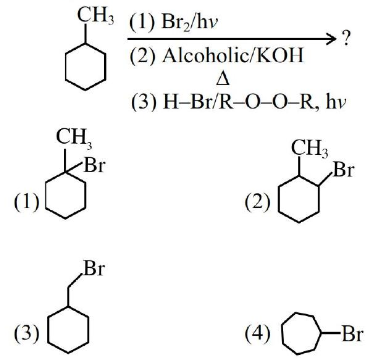
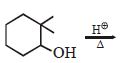
Predict the major product of the following reaction sequence :-
Image
Major product is
In the long form of periodic table, the element having lowest ionisation potentials are present in
Which set of compounds in the following pair of ionic compounds has the higher  lattice energy? 

$(i)\, KCl$ or $MgO$     $(ii) \,LiF$ or $LiBr$    $(iii)\, Mg_3N_2$ or $NaCl$

Fluorine is prepared by