Question
What will be the minimum cost?
Answer


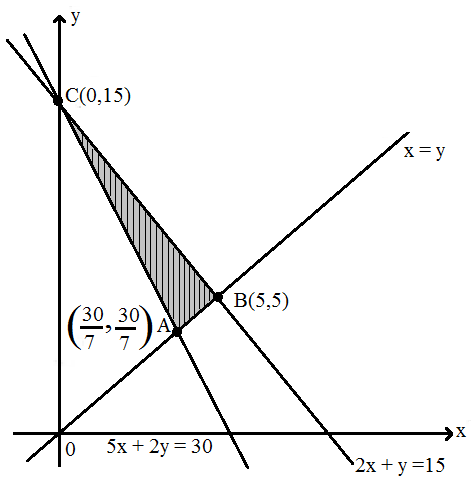
We have minimize z = 400x + 200y, subject to
$5\text{x}+2\text{y}\geq30$
$2\text{x}+\text{y}\leq15$
$\text{x}\leq\text{y}$
$\text{x}\geq0,\text{y}\geq0$
These inequalities are plotted as shown in the adjucent figure.
From the figure shaded region is bounded with the corner points $\text{A}\Big(\frac{30}{7},\frac{30}{7}\Big),$ B(5, 5) and C(0, 15).
Corner points
Corresponding value of Z = 400x + 200
$(0, 15)$
$3000$
$(5,5)$
$3000$
$\Big(\frac{30}{7},\frac{30}{7}\Big)$
$400\times\frac{30}{7}+200\times\frac{30}{7}=\frac{18000}{7}=2571.43$ (Minimum)
Hence, the minimum cast is Rs. 2571.43.

Need a full question paper?

Generate a complete, print-ready paper with questions like this in minutes — across 16+ boards, with answer keys.

Start Generating Free

Similar questions

Evaluate the following integrals:
$\int\sqrt{2\text{x}-\text{x}^2}\text{dx}$
Verify Rolle's theorem of the following function on the indicated interval
$\text{f}(\text{x})=4^{\sin\text{x}}\text{ on }[0,\pi]$
Amit's mathematics teacher has given him three very long lists of problems with the instruction to submit not more than 100 of them (correctly solved) for credit. The problem in the first set are worth 5 points each, those in the second set are worth 4 points each, and those in the third set are worth 6 points each. Amit knows from experience that he requires on the average 3 minutes to solve a 5 point problem, 2 minutes to solve a 4 point problem, and 4 minutes to solve a 6 point problem. Because he has other subjects to worry about, he can not afford to devote more than $3\frac{1}{2}$ hours altogether to his mathematics assignment. Moreover, the first two sets of problems involve numerical calculations and he knows that he cannot stand more than $2\frac{1}{2}$ hours work on this type of problem. Under these circumstances, how many problems in each of these categories shall he do in order to get maximum possible credit for his efforts? Formulate this as a LPP.
Show that A′A and AA′ are both symmetric matrices for any matrix A.
Solve the following systems of linear equations by cramer's rule : $6x + y - 3z = 5,x + 3y - 2z = 5,2x + y + 4z = 8$
Suppose $N$ is set of natural numbers and $R$, is defined in $N \times N$ such that :
$(a, b) R (c, d) \Leftrightarrow a d(b+c)=b c(a+d)$. Prove that $R$ in equivalence in $N \times N$.
Differentiate the following functions with respect to x:
$\sin(\text{x}^\text{x})$
Solve the following differential equation
$\frac{\text{dy}}{\text{dx}}=\frac{1-\cos\text{x}}{1+\cos\text{x}}$
Solve the following system of homogeneous linear equations:
x + y - 2z = 0,
2x + y - 3z = 0,
5x + 4y - 9z = 0
Find $\frac{\text{dy}}{\text{dx}}$
$\text{y}=(\tan\text{x})^{\cot\text{x}}+(\cot\text{x})^{\tan\text{x}}$