Question
What will be the minimum cost?
Answer


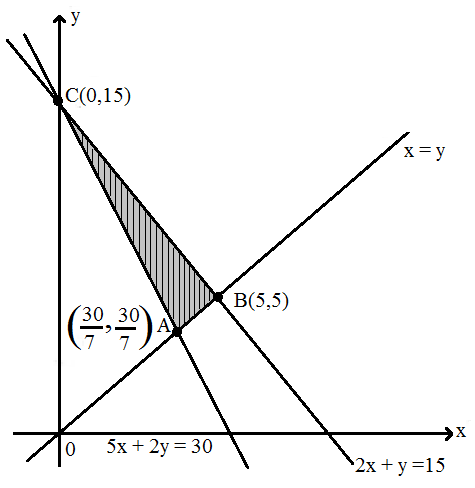
We have minimize z = 400x + 200y, subject to
$5\text{x}+2\text{y}\geq30$
$2\text{x}+\text{y}\leq15$
$\text{x}\leq\text{y}$
$\text{x}\geq0,\text{y}\geq0$
These inequalities are plotted as shown in the adjucent figure.
From the figure shaded region is bounded with the corner points $\text{A}\Big(\frac{30}{7},\frac{30}{7}\Big),$ B(5, 5) and C(0, 15).
Corner points
Corresponding value of Z = 400x + 200
$(0, 15)$
$3000$
$(5,5)$
$3000$
$\Big(\frac{30}{7},\frac{30}{7}\Big)$
$400\times\frac{30}{7}+200\times\frac{30}{7}=\frac{18000}{7}=2571.43$ (Minimum)
Hence, the minimum cast is Rs. 2571.43.

Need a full question paper?

Generate a complete, print-ready paper with questions like this in minutes — across 16+ boards, with answer keys.

Start Generating Free

Similar questions

Evaluate the following integrals as limit of sum:
$\int\limits^3_0(\text{x}+4)\text{dx}$
Solve the following differential equation:
$\frac{\text{dy}}{\text{dx}}+\text{y}\tan\text{x}=\cos\text{x}$
Solve the following systems of homogeneous linear equations by matrix method:
2x + 3y - z = 0
x - y - 2z = 0
3x + y + 3z = 0
Show that the curves $2x = y^2$  and $2xy = k$ cut at right angles, if $k^2 = 8.$
Show that the following systems of linear equations is inconsistent:
3x - y + 2z = 6,
2x - y + z = 2,
3x + 6y + 5z = 20
Evaluate the following integrals:
$ \int\sqrt{\cot}\theta\text{d}\theta$
Verify Rolle's theorem of the following function on the indicated interval
$\text{f}(\text{x})=\sin\text{x}+\cos\text{x}\text{ on }\Big[0,\frac{\pi}{2}\Big]$
Two bad eggs are accidently mixed up with ten good ones. Three eggs are drawn at random with replacement from this lot. Compute the mean for the number of bad eggs drawn.
$\text{Let } \vec{\text a} = \hat{\text{i}} + \hat{\text{j}} + \hat{\text{k}}, \vec{\text{b}} = \hat{\text{i}} \text{ and } \vec{\text{c}} = \text{c}_{1} \hat{\text{i}} + \text{c}_{2} \hat{\text{j}} + \text{c}_{3} \hat{\text{k}}, \text{then}$
  1. Let $c_1 = 1$ and $c_2 = 2$, find $c_3$ which makes $\vec{\text{a}}, \vec{\text{b}} \text{ and }\vec{\text{c}} \text{ coplanar.}$
  2. If $c_2 = –1$ and $c_3 = 1$, show that no value of $c_1$ can make $\vec{\text{a}}, \vec{\text{b}} \text{ and } \vec{\text{c}} \text{ coplanar}.$
If $\text{x}=\text{a}(1-\cos^3\theta),\text{y}=\text{a}\sin^3\theta,$ Prove that $\frac{\text{d}^2\text{y}}{\text{dx}^2}=\frac{32}{27\text{a}}\text{ at}\ \theta=\frac{\pi}{6}$