MCQ
What will be the name of the given reaction
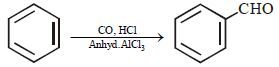
- ✓Gatterman Koch reaction
- BEtard reaction
- CGattermann reaction
- DRosenmund reaction
Generate a complete, print-ready paper with questions like this in minutes — across 16+ boards, with answer keys.
$C{H_3} - \mathop {\mathop {CH - }\limits_{|\,\,\,\,\,\,\,} }\limits_{C{H_3}\,} C{H_2} - C{H_2} - Cl$
$Al_2Cl_6$ $-$ $Al_2(CH_3)_6$ $-$ $AlF_3$ $-$ Dimer of $BeCl_2$ $-$ Dimer of $BeH_2$
(Note : $C$ for complete octet and $IC$ for incomplete octet.)
Assertion $(A):$ The ionic radii of $O ^{2-}$ and $Mg ^{2+}$ are same.
Reason $( R )$ : Both $O ^{2-}$ and $Mg ^{2+}$ are isoelectronic species.
In the light of the above statements, choose the correct answer from the options given below
$C_{(graphite)} +O_2(g) \rightarrow CO_2(g)\,;$
$\Delta _rH^o=-395.5 \, kJ\,mol^{-1}$
$H_2 (g) + \frac{1}{2} O_2 (g) \rightarrow H_2O(l)\,;$ $\Delta _rH^o =-285.8\, kJ\, mol^{-1}$
$CO_2(g) + 2H_2O(l) \rightarrow CH_4(g) + 2O_2(g)\,;$
$\Delta _rH^o = + 890.3\, kJ\, mol^{-1}$
Based on the above thermochemical equations, the value of, $\Delta _rH^o $ at $298\, K$ for the reaction
$C_{(graphite)} + 2H_2(g) \rightarrow CH_4(g) $ will be for $\Delta_{r} H^{\circ}$ ........... $kJ \,mol^{-1}$
| List $-I$ | List $-II$ |
| $(A)$ Phenelzine | $(p)$ Pyrimidine |
| $(B)$ Chloroxylenol | $(q)$ Furan |
| $(C)$ Uracil | $(r)$ Hydrazine |
| $(D)$ Ranitidine | $(s)$ Phenol |
