Question
What will be the values of input A and B for the Boolean expression $\big(\overline{\text{A} + \text{B}}\big) . \big(\overline{\text{A}.\text{B}}\big) = 1?$

Answer

A = 0B = 0

Need a full question paper?

Generate a complete, print-ready paper with questions like this in minutes — across 16+ boards, with answer keys.

Start Generating Free

Similar questions

Can a photon be deflected by an electric field? By a magnetic field?
The drift speed is defined as $\text{v}_\text{d}=\frac{\Delta\text{l}}{\Delta\text{t}}$ where $\Delta\text{l}$ is the distance drifted in a long time $\Delta\text{t}.$ Why don't we define the drift speed as the limit of $\frac{\Delta\text{l}}{\Delta\text{t}}\ \text{as}\ \Delta\text{t}\rightarrow0?$
In the figure given below, on moving a magnet NS kept between two coils AB and CD in the direction of arrow, in which coil the direction of induced current will be anticlockwise when seen from left?
Image
What will be the shape of the wave front of light emerging from a point source?
What is the effect of core on self-induction?
Answer the following questions:
Would the maximum possible magnetisation of a paramagnetic sample be of the same order of magnitude as the magnetisation of a ferromagnet?
Give one example of use of eddy currents.
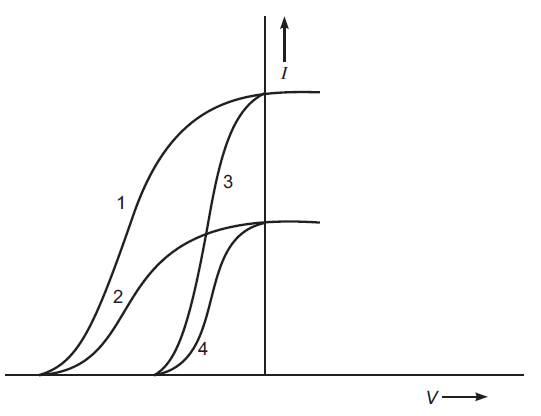
The given graph shows the variation of photo-electric current (I) versus applied voltage (V) for two different photosensitive materials and for two different intensities of the incident radiation. Identify the pairs of curves that correspond to different materials but same intensity radiation.
Answer carefully:Two large conducting spheres carrying charges $Q_1$ and $Q_2$ are brought close to each other. Is the magnitude of electrostatic force between them exactly given by $\frac{\text{Q}_1\text{Q}_2}{{4}\pi\epsilon_{0}\text{r}^{2}}$, where r is the distance between their centres$?$
When the south pole of a bar magnet is taken close to a coil, then what is the direction of induced current in the coil? Explain with reason.