MCQ
When a body thrown vertically upward from the earth's surface is at its maximum height, then its :
  • A
    velocity is maximum
  • B
    acceleration is zero
  • C
    acceleration is maximum
  • velocity is zero

Answer

Correct option: D.
velocity is zero
d

Need a full question paper?

Generate a complete, print-ready paper with questions like this in minutes — across 16+ boards, with answer keys.

Start Generating Free

Similar questions

According to Bernoulli's equation, $\frac{\text{P}}{\rho\text{g}}+\text{h}+\frac{1\text{v}^2}{2\text{g}}=\text{constant}.$ The term, $\frac{\text{P}}{\rho\text{g}},\text{h}$ and $\frac{1\text{v}^2}{\text{2g}}$ are generally called respectively:
Young’s modulus of steel is $1.9 \times 10^{11} \ce{N/m^2}$. When expressed in $\ce{CGS}$ units of $\ce{dynes/cm^2}$, it will be equal to $\ce{(1N = 10^5 dyne, 1m^2 = 10^4cm^2)}$.
The velocity with which a projectile must be fired so that it escapes earth’s gravitation does not depend on
Three rods each of mass $m$ and length $L$ are joined to form an equilateral triangle as shown in the figure. What is the moment of inertia about an axis passing through the centre of mass of the system and perpendicular to the plane?
If the unit of force is $1$ kilo newton, the length is $1 \,km$, and time is $100$ second what will be the unit of mass .............. $kg$
A bullet is fired from a rifle. If the rifle recoils freely, then the kinetic energy of the rifle is
The dimensions of pressure is equal to
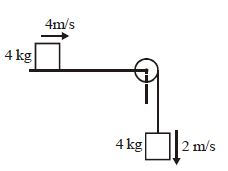
Two blocks of same mass $(4\ kg)$ are placed according to diagram. Initial velocities of bodies are $4\ m/s$ and $2\ m/s$ and the string is taut. Find the impulse on $4\ kg$ when the string again becomes taut  .......... $N-s$
The bob of a pendulum is released from a horizontal position. If the length of the pendulum is $1.\;5 m$, what is the speed (in $m/s$) with which the bob arrives at the lowermost point, given that it dissipated $5\%$ of its initial energy against air resistance ?
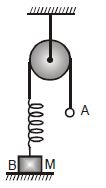
In the figure, the ball $A$ is released from rest when the spring is at its natural (unstretched) length. For the block $B$ of mass $M$ to leave contact with the ground at some stage, the minimum mass of $A$ must be