MCQ
When a buffer solution of sodium acetate and acetic acid is diluted with water
  • A
    Acetate ion concentration increases
  • B
    ${H^ + }$ion concentration increases
  • C
    $O{H^ - }$ion concentration increases
  • ${H^ + }$ion concentration remain unaltered

Answer

Correct option: D.
${H^ + }$ion concentration remain unaltered
(d)Buffer solution have constant $pH$ . When we add the water into this buffer solution. So no effect on it.

Need a full question paper?

Generate a complete, print-ready paper with questions like this in minutes — across 16+ boards, with answer keys.
Start Generating Free

Similar questions

For $3d_{z^2}$ calculate the value of $n, \ell , m$ and $s$
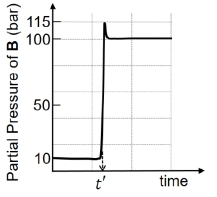
Consider the reaction $A \rightleftharpoons B$ at $1000 K$. At time $t ^{\prime}$, the temperature of the system was increased to $2000 K$ and the system was allowed to reach equilibrium. Throughout this experiment the partial pressure of $A$ was maintained at $1$ bar. Given below is the plot of the partial pressure of B with time. What is the ratio of the standard Gibbs energy of the reaction at $1000 K$ to that at $2000 K$ ?
The formula of a gaseous hydrocarbon which requires $6$ times of its own volume of $O _{2}$ for complete oxidation and produces $4$ times its own volume of $CO _{2}$ is $C _{ x } H _{ y }$. The value of $y$ is ...... .
A weak base $MOH$ of $0.1\,N$ concentration shows a $pH$ value of  $9$ . What is the percentage degree of ionization of the base ? .......$\%$
Given 

$F{e^{ + 3}}\left( {aq} \right) + {e^ - } \to F{e^{2 + }}\left( {aq} \right);{E^o} =  + 0.77\,V$

$A{l^{ + 3}}\left( {aq} \right) + 3{e^ - } \to Al\left( s \right);{E^o} =  - 1.66\,V$

$B{r_2}\left( {aq} \right) + 2{e^ - } \to 2B{r^ - };{E^o} =  + 1.09\,V$

Considering the electrode potentials, which of the following represents the correct order of reducing power?

When benzoic acid dissolve in benzene, the observed molecular mass is
Assertion : $4-$ Nitrochlorobenzene undergoes nucleophilic substitution more readily than chlorobenzene.
Reason : Chlorobenzene undergoes nucleophilic substitution by elimination-addition mechanism while $4-$ nitrochlorobenzene undergoes nucleophilic substitution by addition-elimination mechanism.
The basic structural unit of silicates is
Select the $CORRECT$ set of group number and period of element $''Uub''$ .
The normality of $10 \%$ (mass/volume) acetic acid is: