Question
When a charged particle is placed in an electric field, it experiences an electrical force. If this is the only force on the particle, it must be the net force. The net force will cause the particle to accelerate according to Newton's second law. So $\vec{\text{F}}_\text{e}=\text{q}\vec{\text{E}}=\text{m}\vec{\text{a}}$
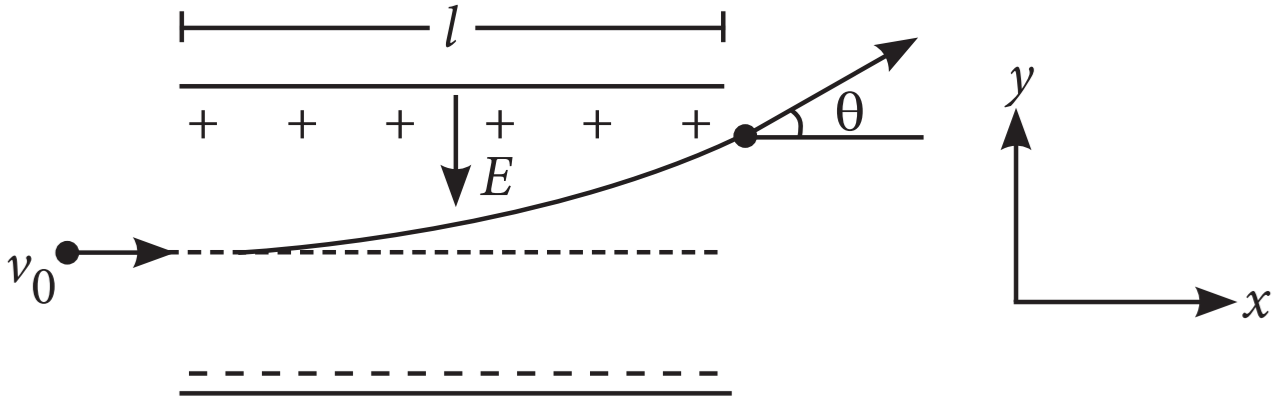
If $\vec{\text{E}}$ is uniform, then $\vec{\text{a}}$ is constant and $\vec{\text{a}}=\text{q}\vec{\text{E}}\text{/ m.}$ If the particle has a positive charge, its acceleration is in the direction of the field. If the particle has a negative charge, its acceleration is in the direction opposite to the electric field. Since the acceleration is constant, the kinematic equations can be used.

  1. An electron of mass m, charge e falls through a distance h metre in a uniform electric field E. Then time of fall,
  1. $\text{t}=\sqrt{\frac{\text{2hm}}{\text{eE}}}$

  2. $\text{t}=\frac{\text{2hm}}{\text{eE}}$

  3. $\text{t}=\sqrt{\frac{\text{2eE}}{\text{hm}}}$

  4. $\text{t}=\frac{\text{2eE}}{\text{hm}}$

  1. An electron moving with a constant velocity v along X-axis enters a uniform electric field applied along Y-axis. Then the electron moves:
  1. With uniform acceleration along Y-axis
  2. Without any acceleration along Y-axis
  3. In a trajectory represented as y = ax2
  4. In a trajectory represented as y = ax
  1. Two equal and opposite charges of masses m1 and m2 are accelerated in an uniform electric field through the same distance. What is the ratio of their accelerations if their ratio of masses is $\frac{\text{m}_1}{\text{m}_2}=0.5?$
  1. $\frac{\text{a}_1}{\text{a}_2}=2$

  2. $\frac{\text{a}_1}{\text{a}_2}=0.5$

  3. $\frac{\text{a}_1}{\text{a}_2}=3$

  4. $\frac{\text{a}_1}{\text{a}_2}=1$

  1. A particle of mass m carrying charge q is kept at rest in a uniform electric field E and then released. The kinetic energy gained by the particle, when it moves through a distance y is:
  1. $\frac{1}{2}\text{qEy}^2$
  2. qEy
  3. qEy2
  4. qE2y
  1. A charged particle is free to move in an electric field. It will travel:
  1. Always along a line of force.
  2. Along a line of force, if its initial velocity is zero.
  3. Along a line of force, if it has some initial velocity in the direction of an acute angle with the line of force.
  4. None of these.

Answer

  1. (a) $\text{t}=\sqrt{\frac{\text{2hm}}{\text{eE}}}$

Explanation:

From Newton's law,

$\text{F}=\text{m}\vec{\text{a}}$

Or $\text{qE}=\text{m}\vec{\text{a}}$

$\Rightarrow\text{a}=\frac{\text{qE}}{\text{m}}=\frac{\text{eE}}{\text{m}}$

Using, $\text{s}=\text{ut}+\frac{1}{2}\text{at}^2$

$\therefore\text{ h}=0+\frac{1}{2}\times\frac{\text{eE}}{\text{m}}\text{t}^2$

$\Rightarrow\text{t}=\sqrt{\frac{\text{2hm}}{\text{eE}}}$

  1. (c) In a trajectory represented as y = ax2
  2. (b) $\frac{\text{a}_1}{\text{a}_2}=0.5$

Explanation:

Force is same in magnitude for both.

$\therefore$ m1a1 = m2a2;

$\frac{\text{a}_1}{\text{a}_2}=\frac{\text{m}_2}{\text{m}_1}=\frac{1}{0.5}=2$

  1. (b) qEy

Explanation:

Here, u = 0;

$\text{a}=\frac{\text{qE}}{\text{m}};\text{ s}=\text{y}$

Using, v2 - u= 2as

$\Rightarrow\text{v}^2=2\frac{\text{qE}}{\text{m}}\text{y}$

$\therefore\text{ K.E.}=\frac{\text{1}}{\text{2}}\text{my}^2=\text{qEy}$

  1. (b) Along a line of force, if its initial velocity is zero.

Explanation:

If charge particle is put at rest in electric field, then it will move along line of force.

Need a full question paper?

Generate a complete, print-ready paper with questions like this in minutes — across 16+ boards, with answer keys.

Start Generating Free

Similar questions

Cloudy nights are warmer than the nights with clean sky. Explain.
Calculate the orbital period in each of these levels.

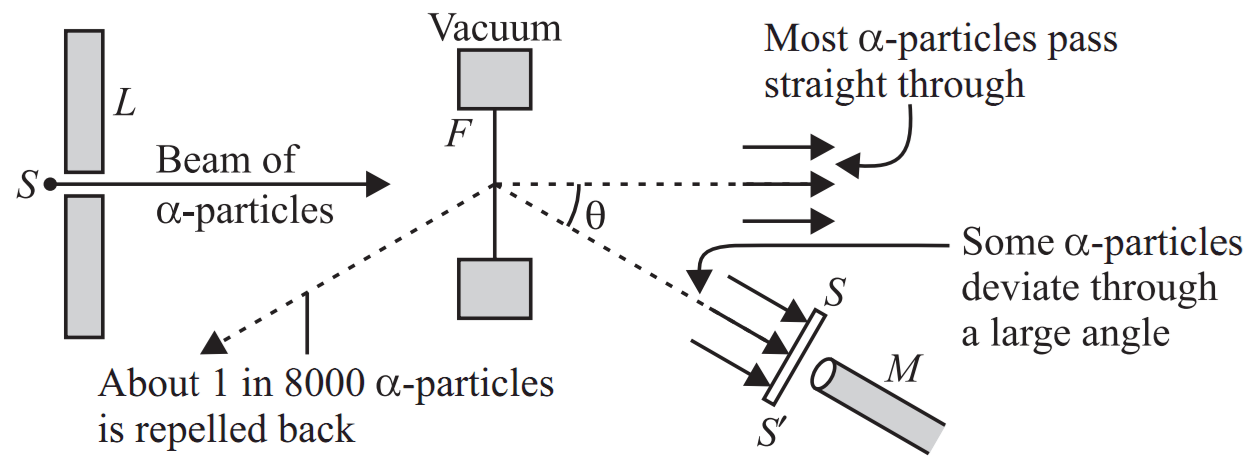
In 1911, Rutherford, along with his assistants, H. Geiger and E. Marsden, performed the alpha particle scattering experiment. H. Geiger and E. Marsden took radioactive source $(^{214}_{83}\text{Bi})$ for $\alpha$- particles. A collimated beam of $\alpha$-particles of energy 5.5 MeV was allowed to fall on 2.1 × 10⁻⁷ m thick gold foil. The $\alpha$-particles were observed through a rotatable detector consisting of a Zinc sulphide screen and microscope. It was found that CL-particles got scattered. These scattered $\alpha$-particles produced scintillations on the zinc sulphide screen. Observations of this experiment are as follows?

Most of the $\alpha$-particles passed through the foil without deflection.

Only about 0.14% of the incident $\alpha$-particles scattered by more than 1º

Only about one $\alpha$-particle in every 8000 $\alpha$-particles deflected by more than 90º

These observations led to many arguments and conclusions which laid down the structure of the nuclear model of an atom.

  1. Rutherford's atomic model can be visualised as.

  1. Gold foil used in Geiger-Marsden experiment is about 10-8 m thick. This ensures.
  1. Gold foil's gravitational pull is small or possible.
  2. Gold foil is deflected when $\alpha$-particle stream is not incident centrally over it.
  3. Gold foil provides no resistance to passage of $\alpha$-particles.
  4. Most $\alpha$-particle will not suffer more than 1º scattering during passage through gold foil.
  1. In Geiger-Marsden scattering experiment, the trajectory traced by an $\alpha$-particle depends on.
  1. Number of collision.
  2. Number of scattered $\alpha$- particles.
  3. Impact parameter.
  4. None of these.
  1. In the Geiger-Marsden scattering experiment, in case of head-on collision, the impact parameter should be.
  1. Maximum
  2. Minimum
  3. Infinite
  4. zero
  1. The fact only a small fraction of the number of incident particles rebound back in Rutherford scattering indicates that.
  1. Number of $\alpha$-particles undergoing head-on-collision is small.
  2. Mass of the atom is concentrated in a small volume.
  3. Mass of the atom is concentrated in a large volume.
  4. Both (a) and (b).
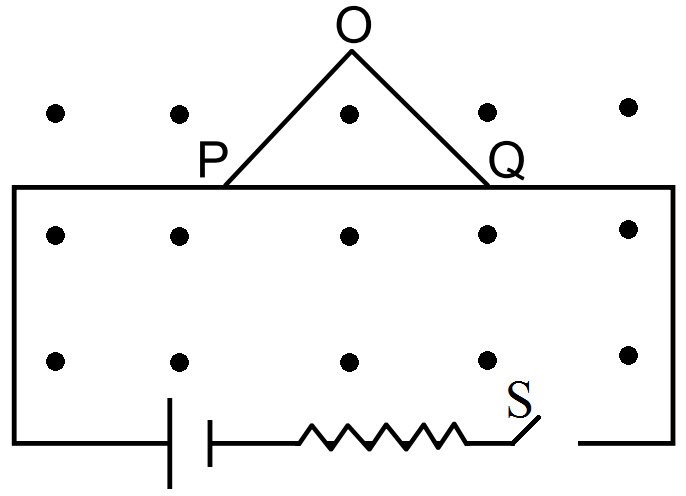
Shows a rod PQ of length 20.0cm and mass 200g suspended through a fixed point O by two threads of lengths 20.0cm each. A magnetic field of strength 0.500T exists in the vicinity of the wire PQ, as shown in the figure. The wires connecting PQ with the battery are loose and exert no force on PQ.
  1. Find the tension in the threads when the switch S is open.
  2. A current of 2.0A is established when the switch S is closed. Find the tension in the threads now.

A van is standing on a frictionless portion of a horizontal road. To start the engine, the vehicle must be set in motion in the forward direction. How can the persons sitting inside the van do it without coming out and pushing from behind?
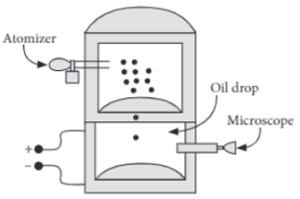
In 1909, Robert Millikan was the first to find the charge of an electron in his now-famous oil-drop experiment. In that experiment, tiny oil drops were sprayed into a uniform electric field between a horizontal pair of oppositely charged plates. The drops were observed with a magnifying eyepiece, and the electric field was adjusted so that the upward force on some negatively charged oil drops was just sufficient to balance the downward force of gravity. That is, when suspended, upward force qE just equaled Mg. Millikan accurately measured the charges on many oil drops and found the values to be whole number multiples of $1.6 \times 10^{-19} C$ the charge of the electron. For this, he won the Nobel prize.
Image
(i) If a drop of mass $1.08 \times 10^{-14} kg$ remains stationary in an electric field of $1.68 \times 10^5 NC ^{-1}$, then the charge of this drop is
(a) $6.40 \times 10^{-19} C$
(b) $4.8 \times 10^{-19} C$
(c) $3.2 \times 10^{-19} C$
(d) $1.6 \times 10^{-19} C$

(ii) Extra electrons on this particular oil drop (given the presently known charge of the electron) are
(a) 4  (b) 5  (c) 8
(d) 3

(iii) A negatively charged oil drop is prevented from falling under gravity by applying a vertical electric field $100 V m ^{-1}$. If the mass of the drop is $1.6 \times 10^{-3} g$, the number of electrons carried by the drop is $( g =10$ $\left.ms ^{-2}\right)$
(a) $10^9$ (b) $10^{18}$ (c) $10^{12}$ (d) $10^{15}$

(iv) The important conclusion given by Millikan's experiment about the charge is
(a) charge has no definite value
(b) charge is quantized
(c) charge is never quantized
(d) charge on oil drop always increases
OR
If in Millikan's oil drop experiment, charges on drops are found to be $8 \mu C , 12 \mu C , 20 \mu C$, then quanta charge is
(a) $20 \mu C$
(b) $12 \mu C$
(c) $8 \mu C$
(d) $4 \mu C$
An ideal gas is pumped into a rigid container having diathermic walls so that the temperature remains constant. In a certain time interval, the pressure in the container is doubled. Is the internal energy of the contents of the container also doubled in the interval?
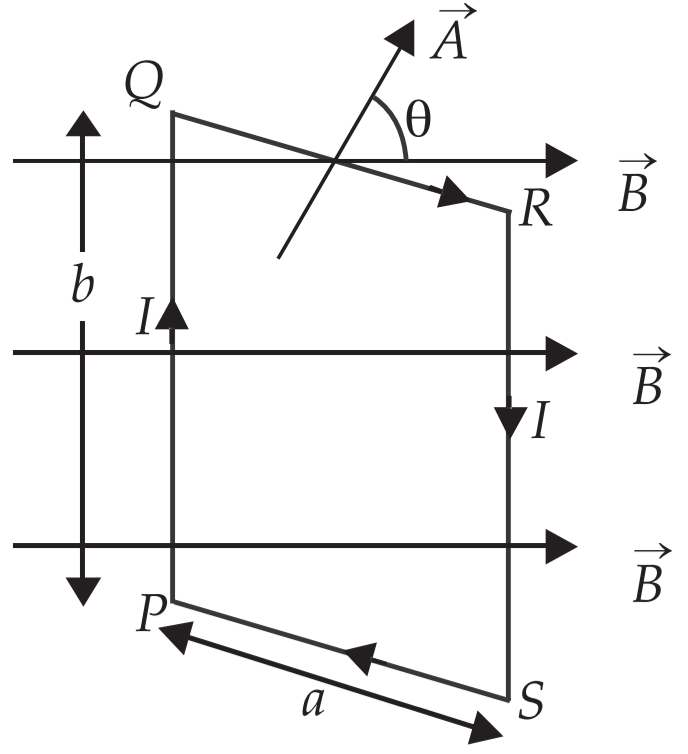
When a rectangular loop PQRS of sides' a' and' b' carrying current I is placed in uniform magnetic field B, such that area vector ii makes an angle 8 with direction of magnetic field, then forces on the arms QR and SP of loop are equal, opposite and collinear, thereby perfectly cancel each other, whereas forces on the arms PQ and RS of loop are equal and opposite but not collinear, so they give rise to torque on the loop.

Force on side PQ or RS of loop is F = JbB sin 90º = lb B and perpendicular distance between two non-collinear forces is $\text{r}_\bot=\text{a}\sin\theta$

So, torque on the loop. $\tau=\text{IAB}\sin\theta$

In vector form torque, $\vec{\tau}=\vec{\text{M}}\times\vec{\text{B}}$

Where $\vec{\text{M}}=\text{NI}\vec{\text{A}}$ is called magnetic dipole moment of current loop and is directed in direction of area vector $\vec{\text{A}}$ i.e., normal to the plane ofloop.

  1. A circular loop of area 1cm2, carrying a current of 10A is placed in a magnetic field of 0.1T perpendicular to the plane of the loop. The torque on the loop due to the magnetic field is:
  1. Zero
  2. 10-4Nm
  3. 10-2Nm
  4. 1Nm
  1. Relation between magnetic moment and angular velocity is:
  1. $\text{m}\propto\omega$

  2. $\text{m}\propto\omega^2$

  3. $\text{m}\propto\sqrt{\omega}$

  4. None of these.
  1. A current loop in a magnetic field:
  1. Can be in equilibrium in two orientations, both the equilibrium states are unstable.
  2. Can be in equilibrium in two orientations, one stable while the other is unstable.
  3. Experiences a torque whether the field is uniform or non uniform in all orientations.
  4. Can be in equilibrium in one orientation.
  1. The magnetic moment of a current I carrying circular coil of radius rand number of turns N varies as:
  1. $\frac{1}{\text{r}^2}$
  2. $\frac{1}{\text{r}}$

  3. $\text{r}$

  4. $\text{r}^2$
  1. A rectangular coil carrying current is placed in a non-uniform magnetic field. On that coil the total:
  1. Force is non-zero.
  2. Force is zero.
  3. Torque is zero.
  4. ZNone of these.  
The household supply of electricity is at 220V (rms value) and 50Hz. Find the peak voltage and the least possible time in which the voltage can change from the rms value to zero.
In the derivation of P1 - P2 = Pgz, it was assumed that the liquid is incompressible. Why will this equation not be strictly valid for a compressible liquid?