Question
When a current/ flows through a coil, flux linked with it is $\phi=\text{LI},$ where L is a constant known as self inductance of the coil. Any change in current sets up an induced emf in the coil. Tims, self inductance of a coil is the induced emf set up in it when the current passing through it changes at the unit rate. It is a measure of the opposition to the growth or the decay of current flowing through the coil. Also, value of self inductance depends on the number of turns in the solenoid, its area of cross-section and the relative permeability of its core material.
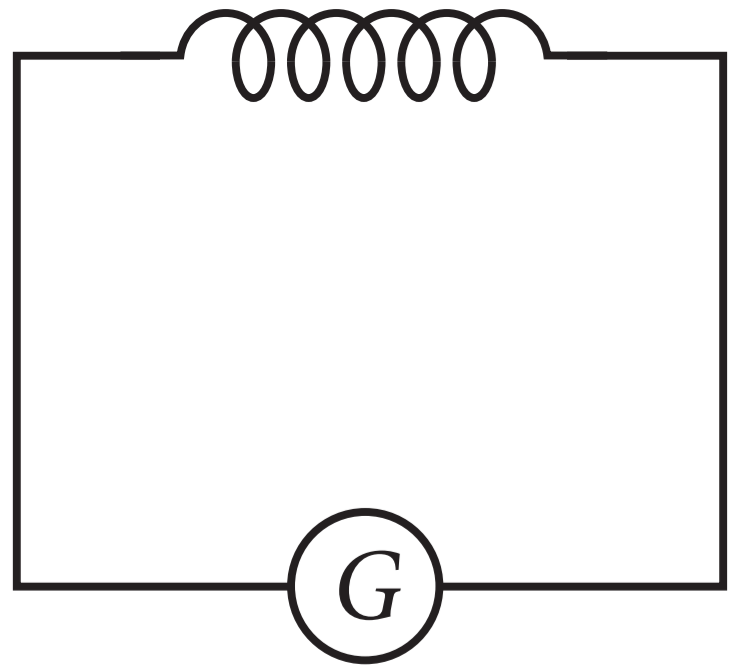
  1. The inductance in a coil plays the same role as:
  1. Inertia in mechanics.
  2. Energy in mechanics.
  3. Momentum in mechanics.
  4. Force in mechanics.
  1. A current of 2.5A flows through a coil of inductance 5H. The magnetic flux linked with the coil is:
  1. 0.5Wb
  2. 12.5Wb
  3. Zero
  4. 2Wb
  1. The inductance L of a solenoid depends upon its radius R as:
  1. $\text{L}\propto\text{R}$

  2. $\text{L}\propto\frac{1}{\text{R}}$

  3. $\text{L}\propto\text{R}^2$

  4. $\text{L}\propto\text{R}^3$

  1. The unit of self-inductance is:
  1. Weber ampere
  2. Weber-1 ampere
  3. Ohm second
  4. Farad
  1. The induced e.m.f. in a coil of 10 henry inductance in which current varies from 9A to 4A in 0.2 second is:
  1. 200V
  2. 250V
  3. 300V
  4. 500V 

Answer

  1. (a) Inertia in mechanics.

Explanation:

The inductance in a coil plays the same role as inertia in mechanics.

  1. (b) 12.5Wb

Explanation:

Here, $\text{I}=2.5\text{A},\ \text{L}=5\text{H}$

Magnetic flux linked with the coil is,

$\phi_\text{B}=\text{LI}=(5\text{H})(2.5\text{A})=12.5\text{Wb}$

  1. (b) $\text{L}\propto\frac{1}{\text{R}}$

Explanation:

The inductance of a solenoid is $\text{L}=\mu_0{\text{n}}^2\text{Al}$ where A is the area of cross-section of the solenoid, l its length and n is the number of turns per unit length.

As, $\text{A}=\pi\text{R}^2$ where R is the radius of the solenoid.

$\therefore\text{L}=\mu_0\text{n}^2\pi\text{R}^2\text{l}\Rightarrow\text{L}\propto\text{R}^2$

  1. (c) Ohm second

Explanation:

The magnitude of induced emf is $|\varepsilon|=\text{L}\frac{\text{dl}}{\text{dt}}\Rightarrow\text{L}=\frac{|\varepsilon|\text{dt}}{\text{dl}}$

or, $\text{L}=\frac{\text{volt}\times\text{ second}}{\text{ampere}}=\text{ohm second}$

  1. (b) 250V

Explanation:

Here L = 10 henry I1 = 9A, I2 = 4A and $\triangle\text{t}=0.2$ second

Then induced e.m.f

$\varepsilon_1=-\text{L}\frac{\text{dl}}{\text{dt}}=-\text{L}\frac{\text{l}_2-\text{l}_1}{\triangle\text{t}}=\frac{-10\times(4-9)}{0.2}=\frac{50}{0.2}=250\text{V}$

Need a full question paper?

Generate a complete, print-ready paper with questions like this in minutes — across 16+ boards, with answer keys.

Start Generating Free

Similar questions

A horizontal overhead power line carries a current of 90 A in east to west direction. What is the magnitude and direction of magnetic field due to the current 1.5 m in below the line?
Derive lens Maker formula $\frac{1}{f}=\left(n_{21}-1\right)\left(\frac{1}{R_1}-\frac{1}{R_2}\right)$. Here are the general meanings of the symbols used in the formula. Draw necessary diagram.
A ladder is resting with one end on a vertical wall and the other end on a horizontal floor. Is it more likely to slip when a man stands near the bottom or near the top?
Consider a coin of Example 1.20. It is electrically neutral and contains equal amounts of positive and negative charge of magnitude 34.8kC. Suppose that these equal charges were concentrated in two point charges seperated by,
  1. 1cm $\Big(\sim\frac{1}{2}\times\text{diagonalof theone paisa coin}\Big)$,
  2. 100m (~ length of a long building), and
  3. 106m (radius of the earth). Find the force on each such point charge in each of the three cases. What do you conclude from these results?
What is the de-Broglie wavelength of
(a) A bullet of mass 0.040 kg travelling at the speed of 1.0 km/s,
(b) A ball of mass 0.060 kg moving a t a speed of 1.0 m/s, and
(c) A dust particle of mass $1.0 \times 10^{-9}$ with a speed of 2.2 m/s?
  1. A small compass needle of magnetic moment ‘m’ is free to turn about an axis perpendicular to the direction of uniform magnetic field ‘B’. The moment of inertia of the needle about the axis is ‘I’. The needle is slightly disturbed from its stable position and then released. Prove that it executes simple harmonic motion. Hence deduce the expression for its time period.
  2. A compass needle, free to turn in a vertical plane orients itself with its axis vertical at a certain place on the earth. Find out the values of (i) horizontal component of earth’s magnetic field and (ii) angle of dip at the place.
$q, 2 q, 3 q$ and $4 q$ Coulomb charges are located at the four corners of a square of side a meter each. Prove that the electric field at its centre will be $4 \sqrt{2} \frac{k q}{a^2} N / C$
Explain Bohr's atomic model.
###
State three postulates of Bohr's atomic model.
Two point charges $5 \mu C$ and $-5 \mu C$ are kept at a distance of 1 cm from each other. Calculate the intensity of the electric field at a distance of 0.30 cm from mid-point (i) in the axial position, (ii) in neutral position.
In a microwave oven, the food is kept in a plastic container and the microwave is directed towards the food. The food is cooked without melting or igniting the plastic container. Explain.