Question

When a current passes through a wire whose different parts are maintained at different temperatures, evolution or absorption of heat all along the length of wire is known as

(a) Joule effect

(b) Seebeck effect

(c) Peltier effect

(d) Thomson effect

Answer

(d) Thomson effect

Need a full question paper?

Generate a complete, print-ready paper with questions like this in minutes — across 16+ boards, with answer keys.

Start Generating Free

Similar questions

The permeability $\mu$ of a ferromagnetic substance is :
Which of the following is correct statement:

A long solenoid carrying a current produces a magnetic field B along its axis. If the current is doubled and the number of turns per cm is halved, the new value of the magnetic field is

(a) B

(b) 2 B

(c) 4 B      

(d) B/2

At a certain place the angle of dip is 30° and the horizontal component of earth's magnetic field is 0.50 Oersted. The earth's total magnetic field is

(a)  

(b) 1

(c)  

(d)  

A square of side ‘a’ has charge Q at its centre and charge ‘q’ at one of the corners. The work required to be done in moving the charge ‘q’ from the corner to the diagonally opposite corner is

(a) Zero

(b)  

(c)   

(d)

Which of the following phenomena can explain quantum nature of light

(a) Photoelectric effect

(b) Interference

(c) Diffraction

(d) Polarisation

In the lowest energy level of hydrogen atom, the electron has the angular momentum

(a)  

(b) h/ 

(c) h/2  

(d)  

Dielectric constant for metal is

(a) Zero  

(b) Infinite

(c) 1  

(d) Greater than 1

A semiconductor is cooled from $ T_{1} K $ to $ T_{2} K $, then its resistance will :

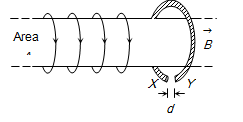
A highly conducting ring of radius R is perpendicular to and concentric with the axis of a long solenoid as shown in fig. The ring has a narrow gap of width d in its circumference. The solenoid has cross sectional area A and a uniform internal field of magnitude B0. Now beginning at t = 0, the solenoid current is steadily increased to so that the field magnitude at any time t is given by B(t) = B0 + at where α > 0. Assuming that no charge can flow across the gap, the end of ring which has excess of positive charge and the magnitude of induced e.m.f. in the ring are respectively

(a) X, A𝛼

(b) X, pR2𝛼

(c) Y, 𝜋A2𝛼

(d) Y, pR2𝛼