Question
When a circuit element ‘X’ is connected across an a.c. source, a current of $\sqrt{2}\text{A}$ flows through it and this current is in phase with the applied voltage. When another element ‘Y’ is connected across the same a.c. source, the same current flows in the circuit but it leads the voltage by $\frac{\pi}{2}$ radians.
  1. Name the circuit element X and Y.
  2. Find the current that flows in the circuit when the series combination of X and Y is connected across the same a.c. voltage.
  3. Net impedance.

Answer

  1. When circuit element is X, the current is in phase with the applied emf, this implies that X is pure resistance.
When circuit element Y is connected, the current leads the voltage by $\frac{\pi}{2}$ so Y is pure capacitance.
  1.  
Resistance of X = R; $\text{I}=\frac{\text{V}}{\text{R}}$

$\sqrt{2}=\frac{\text{V}}{\text{R}} \ ...(\text{i})$

Reactance of $\text{Y, X}_{\text{C}}=\frac{1}{\omega\text{C}},\text{I}=\frac{\text{V}}{\text{X}_{\text{C}}}\Rightarrow\sqrt{2\text{C}}=\frac{\text{V}}{\text{X}_{\text{C}}} \ ...(\text{ii})$

This implies $\text{X}_{\text{C}}=\text{R}$

When R and C are connected in series across same voltage source, then

Impedance $\text{Z}=\sqrt{\text{R}^2+\text{X}^2_{\text{C}}}=\sqrt{\text{R}^2+\text{R}^2}=\sqrt{2}\text{R} \ ...(\text{iii})$

$\therefore$ Current in circuit $\text{I}=\frac{\text{V}}{\text{Z}}=\frac{\text{V}}{\sqrt{2}\text{R}}$

From (1), $\frac{\text{V}}{\text{R}}=\sqrt{2},\therefore\text{I}=\frac{1}{\sqrt{2}}\times\sqrt{2}=1\text{A}$
  1.  
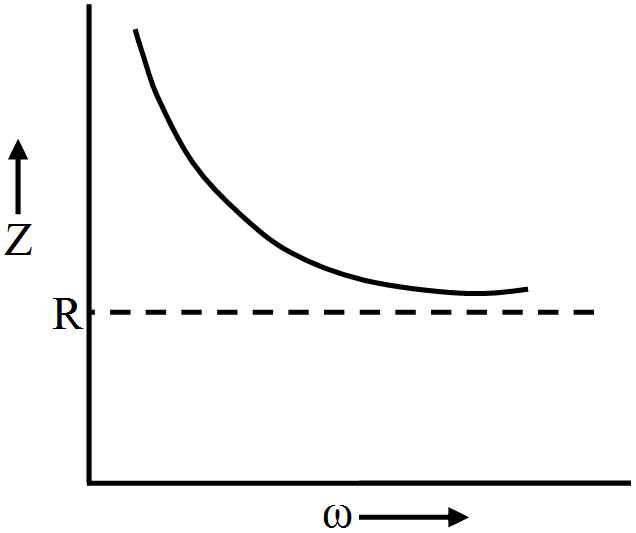
$\text{Z}=\sqrt{\text{R}^2+\Big(\frac{1}{\omega\text{C}}\Big)^2}$

i.e., impedance decreases with increase of angular frequency $\omega$

When $\omega=0,\text{Z}=\infty$

When $\omega=0,\text{Z = R}$

The graph of impedance Z versus $\omega$ is shows in fig.

Need a full question paper?

Generate a complete, print-ready paper with questions like this in minutes — across 16+ boards, with answer keys.

Start Generating Free

Similar questions

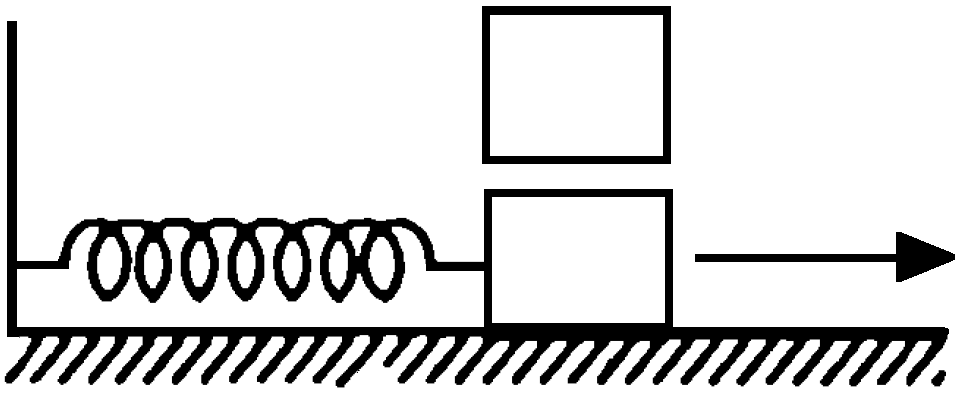
A 1kg block is executing simple harmonic motion of amplitude 0.1m on a smooth horizontal surface under the restoring force of a spring of spring constant 100N/m. A block of mass 3kg is gently placed on it at the instant it passes through the mean position. Assuming that the two blocks move together, find the frequency and the amplitude of the motion.
Answer the following questions:
(a) Are the equations of nuclear reactions (such as those given in Section 13.7) 'balanced' in the sense a chemical equation (e.g., $2 H _2+ O _2 \rightarrow 2 H _2 O$ ) is? If not, in what sense are they balanced on both sides?
(b) If both the number of protons and the number of neutrons are conserved in each nuclear reaction, in what way is mass converted into energy (or vice-versa) in a nuclear reaction?
(c) A general impression exists that mass-energy interconversion takes place only in nuclear reaction and never in chemical reaction. This is strictly speaking, incorrect. Explain.
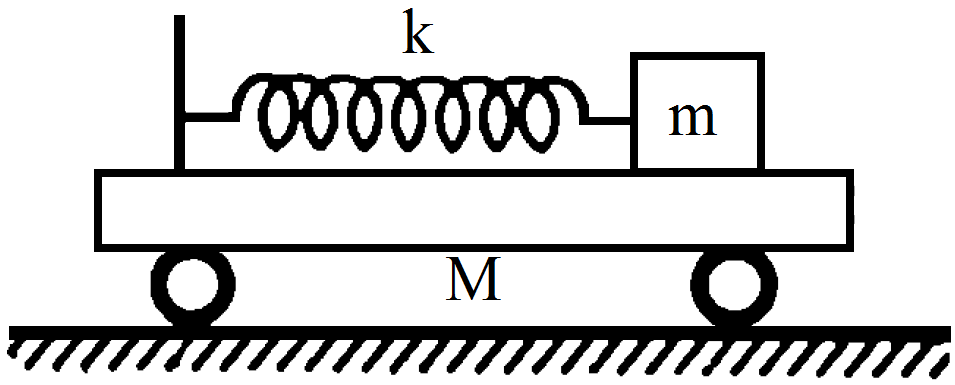
All the surfaces shown in are frictionless. The mass of the car is M, that of the block is m and the spring has spring constant k. Initially, the car and the block are at rest and the spring is stretched through a length x, when the system is released.
  1. Find the amplitudes of the simple harmonic motion of the block and of the car as seen from the road.
  2. Find the time period(s) of the two simple harmonic motions.
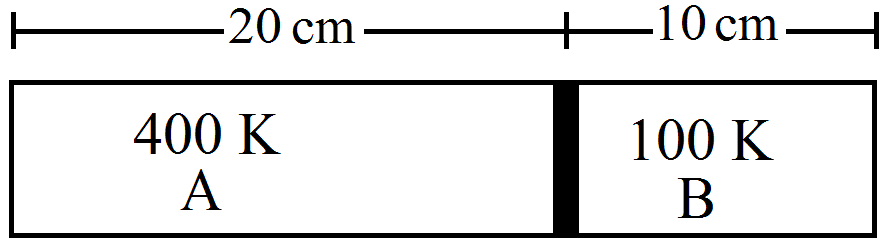
Figure. shows a cylindrical tube of length 30cm which is partitioned by a tight-fitting separator. The separator is very weakly conducting and can freely slide along the tube. Ideal gases are filled in the two parts of the vessel. In the beginning, the temperatures in the parts A and B are 400K and 100K respectively. The separator slides to a momentary equilibrium position shown in the figure. Find the final equilibrium position of the separator, reached after a long time.
Radiations of frequency $10^{15}Hz$ are incident on two photosensitive surfaces A and B. Following observations are recorded:
Surface A: No photoemission takes place.
Surface B: Photoemission takes place but photoelectrons have zero energy.
Explain the above observations on the basis of Einstein’s photoelectric equation. How will the observation with surface B change when wavelength of incident light is decreased?
A conducting wire XY of mass m and neglibile resistance slides smoothly on two parallel conducting wires as shown in Fig. The closed circuit has a resistance R due to AC. AB and CD are perfect conductors. There is a magnetic field $\text{B}=\text{B}(\text{t})\hat{\text{k}}$.
  1. Write down equation for the acceleration of the wire XY.
  2. If B is independent of time, obtain v(t), assuming $v(0) = u_0.$
  3. For (b), show that the decrease in kinetic energy of XY equals the heat lost in R.
Answer the following question:
Some scientists have predicted that a global nuclear war on the earth would be followed by a severe ‘nuclear winter’ with a devastating effect on life on earth. What might be the basis of this prediction?
A projectile is fired with a speed u at an angle $\theta$ above a horizontal field. The coefficient of restitution of collision between the projectile and the field is e. How far from the starting point, does the projectile makes its second collision with the field?
Answer the following the questions.
  1. A small compass needle of magnetic moment ‘m’ is free to turn about an axis perpendicular to the direction of uniform magnetic field ‘B’. The moment of inertia of the needle about the axis is ‘I’. The needle is slightly disturbed from its stable position and then released. Prove that it executes simple harmonic motion. Hence deduce the expression for its time period.
  2. A compass needle, free to turn in a vertical plane orients itself with its axis vertical at a certain place on the earth. Find out the values of (i) horizontal component of earth’s magnetic field and (ii) angle of dip at the place.
Two particles A and B, each having a charge Q, are placed a distance d apart. Where should a particle of charge q be placed on the perpendicular bisector of AB so that it experiences maximum force What is the magnitude of this maximum force?