Question
When a ferromagnetic material goes through a hysteresis loop, the magnetic susceptibility:
  1. Has a fixed value.
  2. May be zero.
  3. May be infinity.
  4. May be negative.

Answer

  1. May be zero.
  2. May be infinity.
  3. May be negative.
Explanation:
When a ferromagnetic material goes through a Hysteresis loop, the Magnetic susceptibility may be zero, may be infinity or may be negative.

Need a full question paper?

Generate a complete, print-ready paper with questions like this in minutes — across 16+ boards, with answer keys.
Start Generating Free

Similar questions

If a linear isotropic dielectric is placed in an electric field of strength E, then the polarization P is:
A resistance $R$ is to be measured using a meter bridge. Student chooses the standard resistance $S$ to be $100\Omega.$ He finds the null point at $l_1 = 2.9\ cm.$ He is told to attempt to improve the accuracy. Which of the following is a useful way?
A parallel beam of light is incident on a converging lens parallel to its principal axis. As one moves away from the lens on the other side on its principal axis, the intensity of light:
Which of the following statements are true regarding radioactivity
(I)  All radioactive elements decay exponentially with time
(II)  Half life time of a radioactive element is time required for one half of the radioactive atoms to disintegrate
(III)  Age of earth can be determined with the help of radioactive dating
(IV)  Half life time of a radioactive element is 50% of its average life period
Select correct answer using the codes given below
Codes :(a) I and II(b) I, III and IV(c) I, II and III(d) II and III
       
Instantaneous displacement current 1A in the space between the parallel plates of $1\mu\text{F}$ capacitor can be established by changing the potential difference at the rate of:
The cold junction of a thermocouple is maintained at 10℃. No thermo e.m.f. is developed when the hot junction is maintained at 530 ℃ . The neutral temperature is(a) 260℃(b) 270℃(c) 265℃(d) 520℃
       
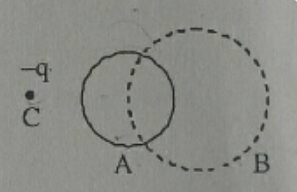
In the figure shown here, A is a conducting sphere and B is a closed spherical surface. If a-q change is placed at C near A, then the electric flux through the closed surface is -
A point $Q$ lies on the perpendicular bisector of an electrical dipole of dipole moment $p$. If the distance of $Q$  from the dipole is $r\ ($much larger than the size of the dipole$),$ then electric field at $Q$ is proportional to
The refractive index of flint glass for blue F line is 1.6333 and red C line is 1.6161. If the refractive index for yellow D line is 1.622, the dispersive power of the glass is(a) 0.0276(b) 0.276(c) 2.76(d) 0.106
       
In comparing e.m.f.s of 2 cells with the help of potentiometer, at the balance point, the current flowing through the wire is taken from: