MCQ
When a lamp is connected in series with capacitor, then
  • Lamp will not glow
  • B
    Lamp will burst out
  • C
    Lamp will glow normally
  • D
    None of these

Answer

Correct option: A.
Lamp will not glow
a
(a) When a lamp is connected to $D.C.$ line with a capacitor. If will form an open circuit. Hence, the lamp will not glow.

Need a full question paper?

Generate a complete, print-ready paper with questions like this in minutes — across 16+ boards, with answer keys.

Start Generating Free

Similar questions

An electric field is given by $(6 \hat{i}+5 \hat{j}+3 \hat{k}) \ N / C$.

The electric flux through a surface area $30 \hat{\mathrm{i}}\; m^2$ lying in $YZ-$plane (in SI unit) is
A charge Q is divided into two parts of q and Q - q. If the coulomb repulsion between them when they are separated is to be maximum, the ratio of $\frac{Q}{q}$ should be
Two long straight parallel wires, carrying (adjustable) current $I_1$ and $I_2$, are kept at a distance $d$ apart. If the force $'F'$ between the two wires is taken as 'positive' when the wires repel each other and 'negative' when the wires attract each other, the graph showing the dependence of $'F'$, on the product $I_1 I_2$, would be
The number of turns in a coil of wire of fixed radius is $600$ and its self inductance is $108\ mH$. The self inductance of a coil of $500$ turns will be:
The dielectric strength of air at NTP is $3\times 10^6 V/m$ then the maximum charge that can be given to a spherical conductor of radius 3 m is
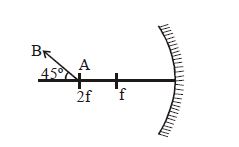
The shape of image formed of an object $AB$ due to the concave mirror shown in the figure is best represented by (assume point $A$ is at the centre of curvature of the mirror) :-
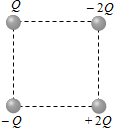
Four charges are placed on corners of a square as shown in figure having side of 5cm. If Q is one microcoulomb, then electric field intensity at centre will be
A moving conductor coil in a magnetic field produces an induced $e.m.f$. This is in accordance with
Consider an atom with atomic number $Z$ as consisting of a positive point charge at the centre and surrounded by a distribution of negative electricity uniformly distributed within a sphere of radius $R$. The electric field at a point inside the atom at a distance $r$ from the centre is
Assertion : Between any two given energy levels, the number of absorption transitions is always less than the number of emission transitions.
Reason : Absorption transitions start from the lowest energy level only and may end at any higher energy level. But emission transitions may start from any higher energy level and end at any energy level below it.