MCQ
When a magnetic substance is heated, then it
  • A
    Becomes a strong magnet
  • Losses its magnetism
  • C
    Does not effect the magnetism
  • D
    Either $(a)$ or $ (c)$

Answer

Correct option: B.
Losses its magnetism
b
(b) When a magnetic substance is heated it loses its magnetic property. It is because all the atomic magnet becomes randomly oriented due to heat.

Need a full question paper?

Generate a complete, print-ready paper with questions like this in minutes — across 16+ boards, with answer keys.
Start Generating Free

Similar questions

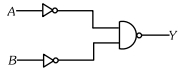
For the following logic circuit, the truth table is:
According to Bohr's theory, the expressions for the kinetic and potential energy of an electron revolving in an orbit is given respectively by
The correct curve between the stopping potential $(V)$ and intensity of incident light $(I)$ is
The magnetic flux through a coil perpendicular to its plane is varying according to the relation $\phi=$ $\left(5 t^{3}+4 t+2 t-5\right) \; Weber$. If the resistant of the coil is $5 \; ohm$, then the induced current through the coil at $t =2 \; sec$ will be $....\,A$
If a current of 10 A flows in one second through a coil, and the induced e.m.f. is 10 V, then the self-inductance of the coil is
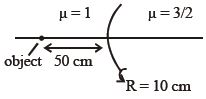
Find Image distance....$cm$
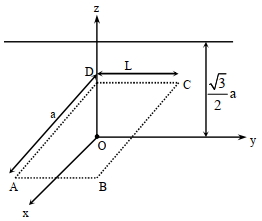
An infinitely long uniform line charge distribution of charge per unit length $\lambda$ lies parallel to the $y$-axis in the $y-z$ plane at $z=\frac{\sqrt{3}}{2} a$ (see figure). If the magnitude of the flux of the electric field through the rectangular surface $A B C D$ lying in the $x-y$ plane with its center at the origin is $\frac{\lambda L }{ n \varepsilon_0}\left(\varepsilon_0=\right.$ permittivity of free space $)$, then the value of $n$ is
Two point charge $-q$ and $+q/2$ are situated at the origin and at the point $(a, 0, 0)$ respectively. The point along the $X$ - axis where the electric field vanishes is
The hysteresis cycle for the material of permanent magnet is:
When a point source of light is at a distance of $50 \,cm$ from a photoelectric cell, the cut-off voltage is found to be $V_0$. If the same source is placed at a distance of $1 \,m$ from the cell, then the cut-off voltage will be