MCQ
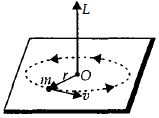
When a mass is rotating in a plane about a fixed point, its angular momentum is directed along 
  • a line perpendicular to the plane of rotation
  • B
    the radius
  • C
    the tangent to the orbit
  • D
    the line making an angle of $45°$ to the plane of rotation
Answer

Correct option: A.
a line perpendicular to the plane of rotation
a
When a mass is rotating in a plane about a fixed point its angular momentum is directed along a line perpendicular to the plane of rotation.

Need a full question paper?

Generate a complete, print-ready paper with questions like this in minutes — across 16+ boards, with answer keys.
Start Generating Free

Similar questions

A cathode ray tube contains a pair of parallel metal plates $1.0\, cm$ apart and $3.0\, cm$ long. A narrow horizontal beam of electron with a velocity $3 \times 10^7\, m/s$ passed down the tube midway between the plates. When a potential difference of $550\, V$ is maintained across the plates, it is found that the electron beam is so deflected that it just strikes the end of one of the plates. Then the specific charge of the electron in $C/kg$ is
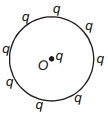
A point charge $q$ is surrounded by eight identical charges at distance $r$ as shown in figure. How much work is done by the forces of electrostatic repulsion when the point charge at the centre is removed to infinity?
For a given angle of the projectile if the initial velocity is doubled the range of the projectile becomes
The output voltage (taken across the resistance) of a $L-C-R$ series resonant circuit falls to half its peak value at a frequency of $200 \,Hz$ and again reaches the same value at $800 \,Hz$. The bandwidth of this circuit is ............. $\,Hz$
A wire of length $1 \,m$ is moving at a speed of $2\,ms^{-1}$ perpendicular to its length and a homogeneous magnetic field of $0.5\,T$. The ends of the wire are joined to a circuit of resistance $6$ $\Omega$ The rate at which work is being done to keep the wire moving at constant speed is
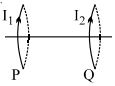
Two circular coils $P$ and $Q$ are fixed coaxially and carry currents $I_1 $ and $I_2$ respectively
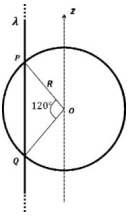
An infinitely long thin non-conducting wire is parallel to the $z$-axis and carries a uniform line charge density $\lambda$. It pierces a thin non-conducting spherical shell of radius $R$ in such a way that the arc $PQ$ subtends an angle $120^{\circ}$ at the centre $O$ of the spherical shell, as shown in the figure. The permittivity of free space is $\epsilon_0$. Which of the following statements is (are) true?

$(A)$ The electric flux through the shell is $\sqrt{3} R \lambda / \epsilon_0$

$(B)$ The z-component of the electric field is zero at all the points on the surface of the shell

$(C)$ The electric flux through the shell is $\sqrt{2} R \lambda / \epsilon_0$

$(D)$ The electric field is normal to the surface of the shell at all points
Width of one of the two slits in a Young's double slit interference experiment is half of the other slit. The ratio of the maximum to the minimum intensity in the interference pattern is :
The average speed $v$ and $r.m.s.$ speed $\bar v$ of the molecules are related as
A spherical bubble inside water has radius $R$. Take the pressure inside the bubble and the water pressure to be $p_0$. The bubble now gets compressed radially in an adiabatic manner so that its radius becomes $(R-a)$. For $a \ll R$ the magnitude of the work done in the process is given by $\left(4 \pi p_0 R a^2\right) X$, where $X$ is a constant and $\gamma=C_p / C_V=41 / 30$. The value of $X$ is. . . . . .