MCQ
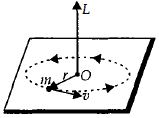
When a mass is rotating in a plane about a fixed point, its angular momentum is directed along 
  • a line perpendicular to the plane of rotation
  • B
    the radius
  • C
    the tangent to the orbit
  • D
    the line making an angle of $45°$ to the plane of rotation
Answer

Correct option: A.
a line perpendicular to the plane of rotation
a
When a mass is rotating in a plane about a fixed point its angular momentum is directed along a line perpendicular to the plane of rotation.

Need a full question paper?

Generate a complete, print-ready paper with questions like this in minutes — across 16+ boards, with answer keys.
Start Generating Free

Similar questions

Let the angle between two nonzero vectors $\overrightarrow{\text{A}}$ and $\overrightarrow{\text{B}}$ be 120° and its resultant be $\vec{\text{c}}:$
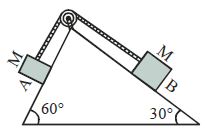
Two blocks each of mass $M$ are resting on a frictionless inclined plane as shown in figure. Then
A body projected along a frictionless inclined plane of angle of inclination $30^o$ covers a distance of $40\, m$ along the plane. If the body is projected with the same speed at angle of $30^o$ with the ground, it will have a range of : (Take $g = 10\, m/s^2$)
The initial and final temperatures of water as recorded by an observer are $(40.6 \pm 0.2)^{\circ} C$ and $(78.9 \pm 0.3)^{\circ} C .$ Calculate the rise in temperature with proper error limits.
Two metal spheres have radil $r$ and $2 r$ and they emit thermal radiation with maximum intensities at wavelengths $\lambda$ and $2 \lambda$ respectively. The respective ratio of the radiant energy emitted by them per second will be .........
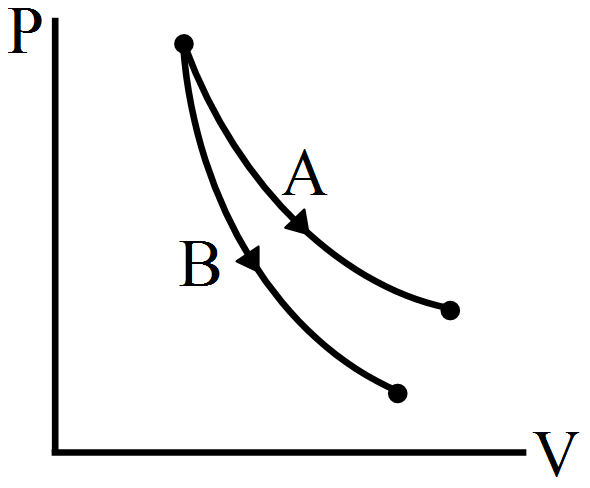
Consider the processes A and B shown in the figure. It is possible that:
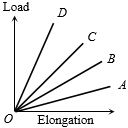
The load versus elongation graph for four wires of the same material is shown in the figure. The thickest wire is represented by the line
A particle is projected at angle $\theta$ with horizontal from ground. The slop $(m)$ of the trajectory of the particle varies with time $(t)$ as ...........
A satellite is moving in a circular orbit at a height $100\ km$ above the earth's surface. A person inside the satellite feels weightless because:
A particle moves for $20 \,seconds$ with velocity $3 \,m/s$ and then velocity $4\, m/s$ for another $20 \,seconds$ and finally moves with velocity $5 \,m/s$ for next $20\, seconds$. What is the average velocity of the particle..........$m/s$