MCQ
When a P - N junction is unbiased, the junction current at equilibrium is:
  • A
    Zero as no charges cross the junctions.
  • B
    Zero as equal number of charge carriers cross the barrier in opposite directions.
  • C
    Mainly due to diffusion of majority charge carriers.
  • D
    Mainly due to diffusion of minority charge carriers.

Answer

  1. Zero as no charges cross the junctions.

Explanation:

When a diode is connected in a Zero Bias condition, no external potential energy is applied to the PN junction. However if the diodes terminals are shorted together, a few holes (majority carriers) in the P-type material with enough energy to overcome the potential barrier will move across the junction against this barrier potential. This is known as the Forward Current.

Likewise, holes generated in the N-type material (minority carriers), find this situation favourable and move across the junction in the opposite direction. This is known as the Reverse Current and is referenced as IR. This transfer of electrons and holes back and forth across the PN junction is known as diffusion.

Then an Equilibrium or balance will be established when the majority carriers are equal and both moving in opposite directions so that the net result is zero current flowing in the circuit. When this occurs the junction is said to be in a state of Dynamic Equilibrium.

Need a full question paper?

Generate a complete, print-ready paper with questions like this in minutes — across 16+ boards, with answer keys.

Start Generating Free

Similar questions

The inductance of a coil is 60μH. A current in this coil increases from 1.0 A to 1.5 A in 0.1 second. The magnitude of the induced e.m.f. is

(a) 60  

(b) 300  

(c) 30  

(d) 3  

In a biprism experiment, by using light of wavelength 5000 Å, 5 mm wide fringes are obtained on a screen 1.0 m away from the coherent sources. The separation between the two coherent sources is

(a) 1.0 mm

(b) 0.1 mm

(c) 0.05 mm

(d) 0.01 mm

A semiconductor is doped with a donor impurity:
  1. The hole concentration increases.
  2. The hole concentration decreases.
  3. The electron concentration increases.
  4. The electron concentration decreases.
To convert galvanometer into voltmeter one should connect:
In order to increase the capacity of a parallel plate condenser, one should introduce a sheet of between the plates (assume that the space is completely filled).
The maximum electric field that a dielectric medium can withstand without break-down is called its:

A long straight wire carrying current of 30A is placed in an external uniform magnetic field of induction 4 × 10⁻⁴ T. The magnetic field is acting parallel to the direction of current. The magnitude of the resultant magnetic induction in tesla at a point 2.0 cm away from the wire is

(a) 10–4

(b) 3 × 10⁻⁴

(c) 5 × 10⁻⁴

(d) 6 × 10⁻⁴

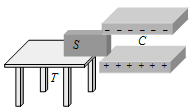
A frictionless dielectric plate S is kept on a frictionless table  T. A charged parallel plate capacitance  C (of which the plates are frictionless) is kept near it. The plate S is between the plates. When the plate S is left between the plates

(a) It will remain stationary on the table

(b) It is pulled by the capacitor and will pass on the other end

(c) It is pulled between the plates and will remain there

(d) All the above statements are false

A glass rod rubbed with silk is used to charge a gold leaf electroscope and the leaves are observed to diverge. The electroscope thus charged is exposed to X-rays for a short period. Then

(a) The divergence of leaves will not be affected

(b) The leaves will diverge further

(c) The leaves will collapse

(d) The leaves will melt

Figure shows the cross-sectional view of the hollow cylindrical conductor with inner radius 'R' and outer radius '2R', cylinder carrying uniformly distributed current along it's axis. The magnetic induction at point 'P' at a distance  from the axis of the cylinder will be

(a) Zero

(b)  

(c)

(d)