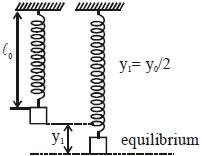
When a particle of mass $m$ is attached to a vertical spring of spring constant $k$ and released, its motion is described by $y ( t )= y _{0} \sin ^{2} \omega t ,$ where $'y'$ is measured from the lower end of unstretched spring. Then $\omega$ is
JEE MAIN 2020, Diffcult


Download our appand get started for free
Experience the future of education. Simply download our apps or reach out to us for more information. Let's shape the future of learning together!No signup needed.*
Similar Questions
- 1A particle executes $S.H.M$ between $x =\, -A$ to $x =\, +A$ . The time taken for it in going from $0$ to $A/2$ is $T_1$ and from $A/2$ to $A$ is $T_2$. ThenView Solution
- 2Speed $v$ of a particle moving along a straight line, when it is at a distance $x$ from a fixed point on the line is given by $v^2 = 108 - 9x^2$ (all quantities in $S.I.$ unit). ThenView Solution
- 3A body is executing simple harmonic motion with an angular frequency $2\,rad/s$. The velocity of the body at $20\, mm$ displacement, when the amplitude of motion is $60\, mm$, is ...... $mm/s$View Solution
- 4A pendulum suspended from the ceiling of a train has a period $T$ when the train is at rest. When the train travels same distance per unit time, the period of oscillation isView Solution
- 5A rod of mass $‘M’$ and length $‘2L’$ is suspended at its middle by a wire. It exhibits torsional oscillations; If two masses each of $‘m’$ are attached at distance $‘L/2’$ from its centre on both sides, it reduces the oscillation frequency by $20\%$. The value of ratio $m/M$ is close toView Solution
- 6A block with mass $M$ is connected by a massless spring with stiffiess constant $k$ to a rigid wall and moves without friction on a horizontal surface. The block oscillates with small amplitude $A$ about an equilibrium position $x_0$. Consider two cases: ($i$) when the block is at $x_0$; and ($ii$) when the block is at $x=x_0+A$. In both the cases, a perticle with mass $m$ is placed on the mass $M$ ?View Solution
($A$) The amplitude of oscillation in the first case changes by a factor of $\sqrt{\frac{M}{m+M}}$, whereas in the second case it remains unchanged
($B$) The final time period of oscillation in both the cases is same
($C$) The total energy decreases in both the cases
($D$) The instantaneous speed at $x_0$ of the combined masses decreases in both the cases
- 7Let $T_1$ and $T_2$ be the time periods of two springs $A$ and $B$ when a mass $m$ is suspended from them separately. Now both the springs are connected in parallel and same mass $m$ is suspended with them. Now let $T$ be the time period in this position. ThenView Solution
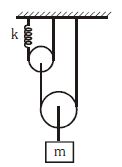
- 8What is the period of small oscillations of the block of mass $m$ if the springs are ideal and pulleys are massless ?View Solution
- 9A mass of $0.2\,kg$ is attached to the lower end of a massless spring of force-constant $200\, N/m,$ the upper end of which is fixed to a rigid support. Which of the following statements is/are true ?View Solution
- 10A $100 \,g$ mass stretches a particular spring by $9.8 \,cm$, when suspended vertically from it. ....... $g$ large a mass must be attached to the spring if the period of vibration is to be $6.28 \,s$.View Solution