Question
When a semiconducting material is doped with an impurity, new acceptor levels are created. In a particular thermal collision, a valence electron receives an energy equal to 2kT and just reaches one of the acceptor levels. Assuming that the energy of the electron was at the top edge of the valence band and that the temperature T is equal to 300K, find the energy of the acceptor levels above the valence band.
Answer

2KT = Energy gap between acceptor band and valency band

$\Rightarrow2\times1.38\times10^{-23}\times300$

$\Rightarrow\text{E}=(2\times1.38\times3)\times10^{21}\text{J}$

$=\frac{6\times1.38}{1.6}\times\frac{10^{-21}}{10^{-19}}\text{eV}=\Big(\frac{6\times1.38}{1.6}\Big)\times10^{-2}\text{eV}$

$=5.175\times10^{-2}\text{eV}=51.75\text{meV}=50\text{meV}.$

Need a full question paper?

Generate a complete, print-ready paper with questions like this in minutes — across 16+ boards, with answer keys.

Start Generating Free

Similar questions

The density of a rod AB continuously increases from A to B. Is it easier to set it in rotation by clamping it at A and applying a perpendicular force at B or by clamping it at B and applying the force at A?
Is potential energy on the surface of earth always zero?
If the angular momentum of two objects with unequal moment of inertia is equal, then which object will have more rotational kinetic energy?
Name at least two prominent phenomena which provide conclusive evidence of molecular motion.
It is true that the triple-point in a singular point of matter, uses modern thermodynamics. How?
What is the ratio of the SI to the CGS units of momentum?
The distance travelled by a moving body is directly proportional to time. Is any external force acting on it?
What is the unit for spring or force constant?
When a load of 2 kg is suspended from a wire its length increased by 1% then calculate the linear strain produced on the wire.
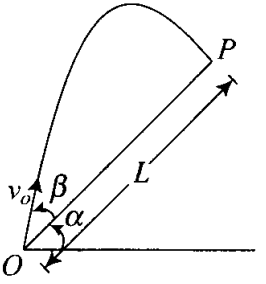
A particle is projected in air at an angle $\beta$ to a surface which itself is inclined at an angle $\alpha$ to the horizontal (Fig.).

  1. Find an expression of range on the plane surface (distance on the plane from the point of projection at which particle will hit the surface).
(Hint: This problem can be solved in two different ways:

  1. Point P at which particle hits the plane can be seen as intersection of its trajectory (parobola) and straight line. Remember particle is projected at an angle $(\alpha+\beta)$ w.r.t. horizontal.
  2. We can take x-direction along the plane and y-direction perpendicular to the plane. In that case resolve g (acceleration due to gravity) in two differrent components, gx along the plane and gy perpendicular to the plane. Now the problem can be solved as two independent motions in x and y directions respectively with time as a common parameter.)