MCQ
When a white light passes through a hollow prism, then
  • There is no dispersion and no deviation
  • B
    Dispersion but no deviation
  • C
    Deviation but no dispersion
  • D
    There is dispersion and deviation both

Answer

Correct option: A.
There is no dispersion and no deviation

Need a full question paper?

Generate a complete, print-ready paper with questions like this in minutes — across 16+ boards, with answer keys.
Start Generating Free

Similar questions

The electric field due to an electric dipole at a distance r from its centre in axial position is E. If the dipole is rotated through an angle of 90° about its perpendicular axis, the electric field at the same point will be
A circular coil of conducting wire has an area $A$ and number of turns $N$. It is lying in a vertical plane in a region where uniform magnetic field $B$ exist with field direction normal to the coil plane. If the coil is rotated about a vertical axis by an angle $π$ in $0.5$ seconds, then the value of the emf induced at the ends of the coil is.
$512$ identical drops of mercury are charged to a potential of $2\, V$ each. The drops are joined to form a single drop. The potential of this drop is ......... $V.$
In a $\text{CRT}$ the acceleration of electrons is controlled by changing $.......$ between the cathode and anode:
A proton and a deutron both having the same kinetic energy, enter perpendicularly into a uniform magnetic field $B$. For motion of proton and deutron on circular path of radius ${R_p}$ and ${R_d}$ respectively, the correct statement is
In a Young's double slit experiment, light from a laser source falls on a pair of very narrow slits separated by $1.0 \,\mu m$ and bright fringes separated by $1.0 \,mm$ are observed on a distant screen. If the frequency of the laser light is doubled, the separation of the bright fringes is .......$\,mm$ ?
Which of the following is $\text{NOT}$ a postulate of Bohr's model of the hydrogen atom?
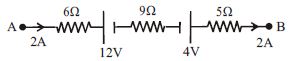
The potential difference between $A$ and $B$ in the Figure is .............. $V$
Two amplifier are connected one after the other in series (cascade). The first amplifier has a voltage gain $10$ and the second has a voltage gain of $20$. If the input signal is $0.01\, V$, the out $ac$ signal will be........$V$
Image formed by a convex mirror is