Question
When an AC source is connected to a capacitor there is a steady-state current in the circuit. Does it mean thatthe charges jump from one plate to the other to complete the circuit?

Answer

No.

Need a full question paper?

Generate a complete, print-ready paper with questions like this in minutes — across 16+ boards, with answer keys.
Start Generating Free

Similar questions

What is the magnitude of magnetic field at the center of a long hollow current carrying tube of copper?
Two identical cells, each of emf $E,$ having negligible internal resistance, are connected in parallel with each other across an external resistance $R.$ What is the current through this resistance?
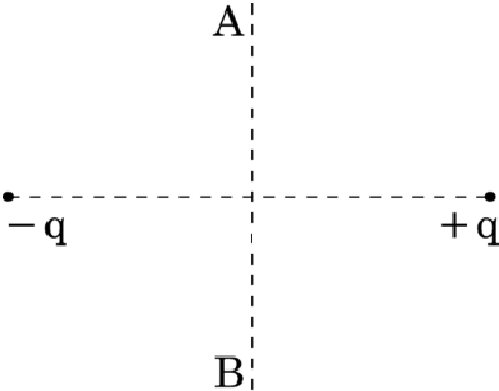
A charge $'q\ '$ is moved from a point $A$ above a dipole of dipole moment $'p\ '$ to a point $B$ below the dipole in equatorial plane without acceleration. Find the work done in the process.
Answer carefully:
What is the work done by the field of a nucleus in a complete circular orbit of the electron? What if the orbit is elliptical?
Write the formula for the magnifying power of a objective lens.
What will be the relationship between the mass loss $\Delta M$ of a nucleus and its binding energy ( E )?
A negligibly small current is passed through a wire of length 15 m and uniform cross-section 6.0 x 10⁻⁷ m2 ,and its resistance is measured to be 5.0 Ω. What is the resistivity of the material at the temperature of the experiment?
Does the magnifying power of a microscope depend on the colour of the light used? Justify your answer.
Magnetic scalar potential is defined as$\text{U}(\overrightarrow{\text{r}_2})-\text{U}(\overrightarrow{\text{r}_1})=-\int\limits^{\vec{\text{r}}_2}_{\vec{\text{r}_1}} \vec{\text{B}}.\text{d}\vec{\text{l}}.$
Apply this equation to a closed curve enclosing a long atraicht wire. The RHS of the above equation is then $-{\mu}_\text{o} \text{ i}$ by Ampere's law. We see that $\text{U}(\vec{\text{r}_2})\neq\text{U}(\vec{\text{r}_1})$ even when $\vec{\text{r}_2}=\vec{\text{r}_1}.$Can we have a magnetic acalar potential in this case?
In a circuit containing a capacitor and an AC source the current is zero at the. stant the source voltage is maximum. Is it consistent with Ohm's law?