Question
  1. When an AC source is connected to an ideal capacitor, show that the average power supplied by the source over a complete cycle is zero.
  2. A bulb is connected in series with a variable capacitor and an A.C. source as shown. What happens to the brightness of the bulb when the key is the capacitor is gradually reduced?
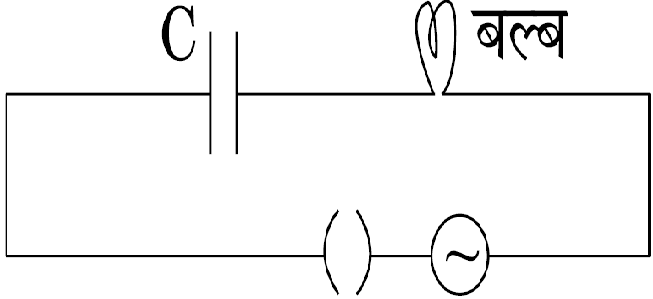
Answer

  1. Let the applied voltage be
$\text{V}= \text{V}_{o}\sin\omega\text{t}$

The current through an ideal capacitor, would then be

$\text{I} = \text{I}_{o}\sin(\omega\text{t} + \frac{\pi}{2}) = \text{I}_{0}\cos\omega\text{t}$

$\therefore\text{P}_{inst} = \text{VI}$

$\therefore\text{P}_{AV} = \frac{1}{\text{T}}\int^{T}_{0}\text{VIdt}$

$\therefore\text{P}_{AV} = \frac{\text{V}_{0}\text{I}_{0}}{2}\langle\sin2\omega\text{t}\rangle$

$=0.$
  1. $\text{X}_{c} = \frac{1}{\omega\text{C}}$
$\therefore\text{X}_{c}$ increases as C decreases. Hence, with decreasing C, the brightness of the bulb would decrease.

Need a full question paper?

Generate a complete, print-ready paper with questions like this in minutes — across 16+ boards, with answer keys.

Start Generating Free

Similar questions

Water is filled in a rectangular tank of size 3m × 2m × 1m.
  1. Find the total force exerted by the water on the bottom surface of the tank.
  2. Consider a vertical side of area 2m × 1m. Take a horizontal strip of width ox metre in this side, situated at a depth of x metre from the surface of water. Find the force by the water on this strip.
  3. Find the torque of the force calculated in part.(b) about the bottom edge of this side.
  4. Find the total force by the water on this side.
  5. Find the total torque by the water on the side about.
The bottom edge. Neglect the atmospheric pressure and take $g = 10m/s^2.$
The focal lengths of a convex lens for red, yellow and violet rays are 100cm, 98cm and 96cm respectively. Find the dispersive power of the material of the lens.
In single slit diffraction, explain why the maxima at $\theta=\left(n+\frac{1}{2}\right)\left(\frac{\lambda}{a}\right)$ becomes weaker and weaker as an increases. State two important differences between interference and diffraction pattern.
A straight wire carrying an electric current is placed along the axis of a uniformly charged ring. Will there be a magnetic force on the wire if the ring starts rotating about the wire? If yes, in which direction?
If several forces act on a particle, the total torque on the particle may be obtained by first finding the resultant force and then taking torque of this resultant. Prove this. Is this result valid for the forces acting on different particles of a body in such a way that their lines of action intersect at a common point?
With the help of a circuit diagram, explain how two p-n junction diodes along with a centre tapped transformer can be used as a full wave rectifier.
Explain the application of $p-n$ junction diode as a full-wave rectifier.
A circular coil of wire consisting of 100 turns, each of radius 8.0 cm carries a current of 0.40 A. What is the magnitude of the magnetic field B at the centre of the coil?
A concave mirror having a radius of curvature 40cm is placed in front of an illuminated point source at a distance of 30cm from it. Find the location of the image.
Draw the graph to show variation of binding energy per nucleon with mass number of different atomic nuclei. Calculate binding energy/nucleon of $^{40}_{20}\text{Ca}$ nucleus.
Given:
mass of $^{40}_{20}\text{Ca} = 39.962589\text{u}$.
mass of proton $= 1.007825$ u.
mass of neutron $= 1.008665$ u.
and $1\ u = 931\ MeV/C^{2.}$