Question
When an electron falls from a higher energy to a lower energy level, the difference in the energies appears in the form of electromagnetic radiation. Why cannot it be emitted as other forms of energy?

Answer

As electrons interact only electromagnetically, so, the transition of an electron from a higher energy to a lower energy level can appears in the form of electromagnetic radiation.

Need a full question paper?

Generate a complete, print-ready paper with questions like this in minutes — across 16+ boards, with answer keys.
Start Generating Free

Similar questions

A wire, carrying a current i, is kept in the x−y plane along the curve $\text{y}=\text{A}\sin\Big(\frac{2\pi}{\lambda}\text{x}\Big).$ A magnetic field B exists in the z direction. Find the magnitude of the magnetic force on the portion of the wire between $\text{x}=0$ and $\text{x}=\lambda.$
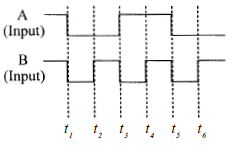
The given inputs A, B are fed to a 2-input NAND gate. Draw the output wave form of the gate.


A point source is placed at a depth h below the surface of water (refractive index = μ).
  1. Show that light escapes through a circular area on the water surface with its centre directly above the point source.
  2. Find the angle subtended by a radius of the area on the source.
Define the term 'Half-life' of a radioactive substance. Two different radioactive substances have half-lives $T _1$ and $T _2$ and number of undecayed atoms at an instant, $N _1$ and $N _2$, respectively. Find the ratio of their activities at that instant.
In a photoelectric effect, the yellow light is just able to emit electrons, will green light emit photoelectrons? What about red light?
Calculate the momentum of a photon of light of wavelength 500nm.
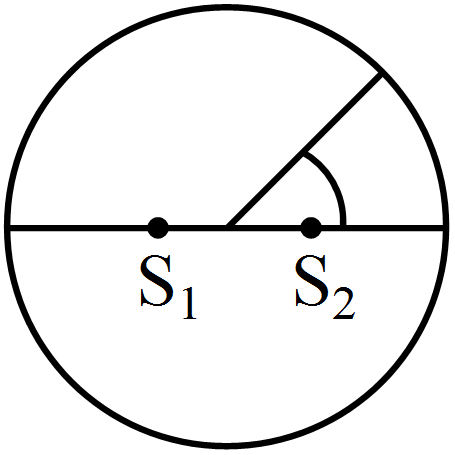
Figure, shows two coherent sources S1 and S2 which emit sound of wavelength $\lambda$ in phase. The separation between the sources is $3\lambda.$ A circular wire of large radius is placed in such a way that S1S2 lies in its plane and the middle point of S1S2 is at the centre of the wire. Find the angular positions $\theta$ on the wire for which constructive interference takes place.

The focal length of a convex lens made of glass is 20cm. What will be its new focal length when placed in a medium of refractive index 1.25?
An inductor-coil of inductance 17mH is constructed from r wire of length 100m and cross-sectional area a copper wire of length 100m and cross-sectional area 1mm2. Calculate the time constant of the circuit if this inductor is joined across an ideal battery. The resistivity of copper $=1.7\times10^{-8}\Omega-\text{m}.$
An electron beam projected along the positive X-axis deflects along the positive Y-axis. If this deflection is caused by a magnetic field, what is the direction of the field? Can we conclude that the field is parallel to the Z-axis?