Question
When an electron in hydrogen atom jumps from the third excited state to the ground state, how would the de Broglie wavelength associated with the electron change? Justify your answer.

Answer

$\lambda = \frac{\text{h}}{\text{P}} = \frac{\text{h}}{\sqrt{2\text{mK}}}$

$\frac{\lambda_{1}}{\lambda_{4}} = \sqrt{\frac{\text{K}_{4}}{\text{K}_{1}}}$

But $\text{K}_{n}( = - \text{E}_{n})\propto\frac{1}{\text{n}^{2}}$

Hence , $\frac{\lambda_{1}}{\lambda_{4}} = \sqrt{\frac{1}{16}}$

$\therefore \frac{\lambda_{1}}{\lambda_{4}} = \frac{1}{4}$

$\lambda_{4} = 4 \lambda_{1}$

i.e. $\lambda_{4} > \lambda_{1}$

Alternate Answer

$\lambda_{n} = \frac{\text{h}}{\text{P}_{n}} = \frac{\lambda}{\text{mv}_{n}}$

Velocity of electron in nth state $\upsilon_{n}\propto\frac{1}{n}$

$\lambda_{n}\propto\frac{1}{\upsilon_{n}}\therefore\lambda\propto\text{n}$

$\therefore \frac{\lambda_{4}}{\lambda_{1}} = \frac{\text{n}_{4}}{\text{n}_{1}} = \frac{4}{1}$

Need a full question paper?

Generate a complete, print-ready paper with questions like this in minutes — across 16+ boards, with answer keys.
Start Generating Free

Similar questions

In the Rutherford's nuclear model of the atom, the nucleus (radius about $10^{-15} m$ ) is analogous to the sun about which the electron move in orbit (radius $\approx 10^{-10} m$ ) like the earth orbits around the sun. If the dimensions of the solar system had the same proportions as those of the atom, would the earth be closer to or farther away from the sun than actually it is? The radius of earth's orbit is about $1.5 \times 10^{11} m$. The radius of sun is taken as $7 \times 10^8 m$.
Answer the following question:
In viewing through a magnifying glass, one usually positions one’s eyes very close to the lens. Does angular magnification change if the eye is moved back?
Balmer series was observed and analysed before the other series. Can you suggest a reason for such an order?
Two metallic wires A and B made from same substance have equal lengths and their cross-sections are in the ratio $1: 2$. They are joined in (i) series (ii) parallel. In both the above combinations, compare the drift velocities of electrons in the two wires.
Define the distance of closest approach. An α-particle of kinetic energy 'K' is bombarded on a thin gold foil. The distance of the closest approach is 'r'. What will be the distance of closest approach for an α-particle of double the kinetic energy?
Deduce the expression for the magnetic dipole moment of an electron orbiting around the central nucleus.
Two charges are placed in air at some distance:(a) If a glass slab whose dielectric constant is 8 is placed between them, then what will be the change in the magnitude of the force acting between them?(b) What will happen if the piece of brass is kept?
Give examples where:
  1. The velocity of a particle is zero but its acceleration is not zero.
  2. The velocity is opposite in direction to the acceleration.
  3. The velocity is perpendicular to the acceleration.
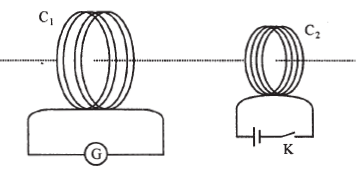
A current is induced in coil C1 due to the motion of current carrying coil C2. (a) Write any two ways by which a large deflection can be obtained in the galvanometer G. (b) Suggest an alternative device to demonstrate the induced current in place of a galvanometer.

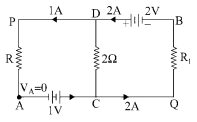
In the given figure, point A is at zero potential. Use Kirchhoff's rules to find out the potential at B.
Image