Question
When an object cools down, heat is withdrawn from it. Does the entropy of the object decrease in this process? If yes, is it a violation of the second law of thermodynamics stated in terms of increase in entropy?

Answer

When an object cools down, heat is withdrawn from it. Hence, the entropy of the object decreases. But the decrease in entropy leads to the transfer of energy to the surrounding. The second law is not violated here, which states that entropy of the universe always increases as the net entropy increases.
Here,
Net entropy = Entropy of object + Entropy of surrounding

Need a full question paper?

Generate a complete, print-ready paper with questions like this in minutes — across 16+ boards, with answer keys.

Start Generating Free

Similar questions

What is escape velocity. Derive an expression for the same.
Consider a head-on collision between two particles of masses m1 and m2. The initial speeds of the particles are u1 and u2 in the same direction. The collision starts 2 at t = 0 and the particles interact for a time interval $\triangle\text{t}.$ During the collision, the speed of the first particle varies as.

$\text{v}(\text{t})=\text{u}_1+\frac{\text{t}}{\triangle\text{t}}(\text{v}_1-\text{u}_1).$

Find the speed of the second particle as a function of time during the collision.
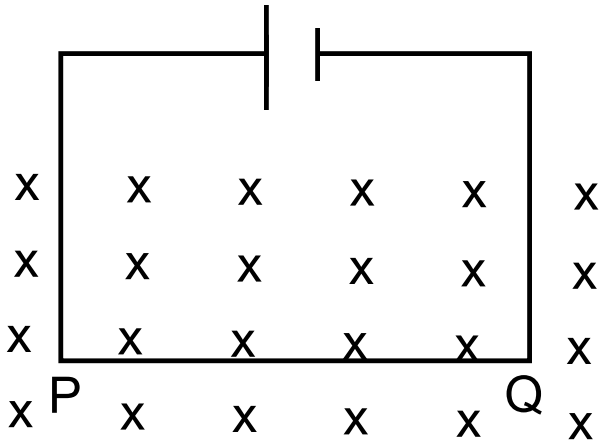
A current of 5.0A exists in the circuit shown in the figure. The wire PQ has a length of 50cm and the magnetic field in which it is immersed has a magnitude of 0.20T. Find the magnetic force acting on the wire PQ.

If $\text{x = a}\cos\omega\text{t + b}\sin\omega\text{t},$ show that it represents S.H.M. 
For an oscillating pendulum, establish the relation, $\frac{\text{d}^2\theta}{\text{dr}^2}+\omega^2=\theta=0,$ Where $\omega^2=\frac{\text{g}}{\text{l}}$ and $\theta$ is small angular displacement.
Calculate the acceleration due to gravity at the surface of Mars if its diameter is 6760km and mass one tenth that of the earth. The diameter of earth is 12742km and acceleration due to gravity on the earth is 9.8m/ s2.
It is a well known fact that during a total solar eclipse the disk of the moon almost completely covers the disk of the Sun. From this fact and from the information you can gather from examples 2.3 and 2.4, determine the approximate diameter of the moon.
Can a satellite be in an orbit in a plane not passing through the earth's centre? Explain your answer.
A body of mass 1.0kg initially at rest is moved by a horizontal force of 0.5N on a smooth frictionless table. Calculate the work done by the force in 10s and show that this is equal to the change in kinetic energy of the body.
What is the Internal energy in the process of vapourisation?