Question
When and how does placenta develop in human female?

Answer

Placenta develops after implantation of embryo in human female in the uterus. After implantation, finger-like projections called chorionic villi are surrounded by the uterine tissue and maternal blood. The chorionic villi and uterine tissue become interdigitated with each other and together form a structural and functional unit between developing embryo and maternal body called placenta.

Need a full question paper?

Generate a complete, print-ready paper with questions like this in minutes — across 16+ boards, with answer keys.

Start Generating Free

Similar questions

Angiosperm flowers may be monoecious, cleistogamous or show self-incompatibility. Describe the characteristic features of each one of them and state which one of these flowers promotes inbreeding and outbreeding respectively.
What is a test cross? How can it decipher the heterozygosity of a plant?###Explain Mendel's Test cross only by figure.###What is a test cross? Show phenotypic ratio 1 : 1 in a monohybrid test cross through punnet square.###During a monohybrid corss involving a tall pea plant with a dwarf pea plant the offspring populations were tall and dwarf in equal ratio work out a cross to show how it possible.
  1. Taking an example of a small pond, explain how the four components of an ecosystem function as a unit.
  2. Name the type of food chain that exists in a pond.
A. Cryptorchidism is a condition in which the testes fail to descend into the scrotum. It can also lead to compromised Sertoli cell function and has an impact on Leydig cell function.
(i) Identify at least 3 parameters of male fertility which get affected due to cryptorchidism.
(ii) Which process will be affected if mature spermatids are not released from Sertoli cells?
(iii) Name and explain one assisted reproductive technology (ART process) in which the sperm/semen is used to assist fertilization.
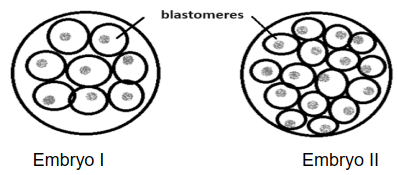
(iv) Name and explain the assisted reproductive technology that should be used to complete the development of embryos I and II shown in the figure given below.
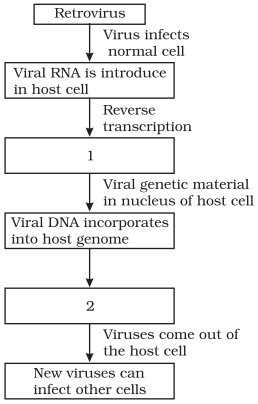
In the given flow diagram, the replication of retrovirus in a host is shown. Observe and answer the following questions,

  1. Fill in (1) and (2).
  2. Why is the virus called retrovirus?
  3. Can the infected cell survive while viruses are being replicated and released?

  1. Draw a diagram of a mature embryo sac of an angiosperm and label the following parts in it:
  1. Filiform apparatus.
  2. Synergids.
  3. Central cell.
  4. Egg cell.
  5. Polar nuclei.
  6. Antipodals.
  1. Write the fate of egg cell and polar nuclei after fertilisation.
Give reasons for the following:
  1. Shivering in malaria.
  2. Plasmodium is considered a digenetic parasite.
  3. Dengue fever is also known as break bone fever.
  4. Swelling of lower limbs in filariasis.
Describe the exponential growth model of a population with diagram and curve.
(A) Write the harmful effects caused by alcohol / drug abuse.
(B) Write a brief note :-
(1) Opioids$\quad$$\quad$(2) Cannabinoids


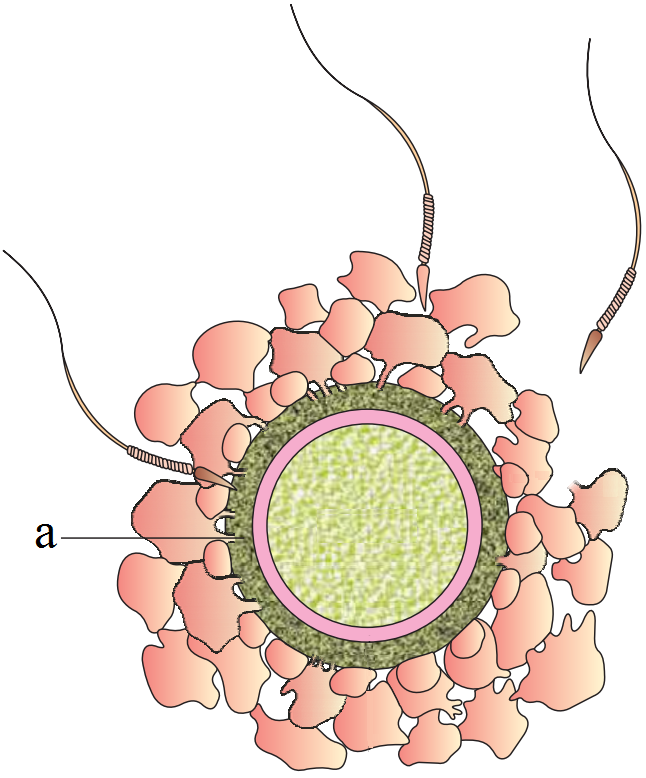
  1. One of the sperms is observed to penetrate 'a' of the ovum, as shown in the above diagram. Name 'a'.
  2. How is the sperm able to do so?
  3. Where exactly in the fallopian tube does this occur?
  4. Explain the events thereafter up to morula stage.