Question
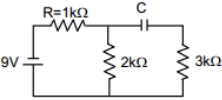
When capacitor is fully charged, find current drawn from the cell. $9\, V $ (in $mA$)
Answer

When the capacitor is fully charged then, it behaves like an open circuit.

So, the current drawn from the cell is,

$I=\frac{V}{R_{e q}}$

$=\frac{9}{2+1}$

$=3 mA$

Need a full question paper?

Generate a complete, print-ready paper with questions like this in minutes — across 16+ boards, with answer keys.

Start Generating Free

Similar questions

The quantum hall resistance $R_H$ is a fundamental constant with dimensions of resistance. If $h$ is Planck's constant and $e$ is the electron charge, then the dimension of $R_H$ is the same as
A particle of mass $0.6\, g$ and having charge of $25\, nC$ is moving horizontally with a uniform velocity ${\rm{1}}{\rm{.2}} \times {\rm{1}}{{\rm{0}}^{\rm{4}}}\,m{s^{ - 1}}$ in a uniform magnetic field, then the value of the magnetic induction is $(g = 10\,m{s^{ - 2}})$
A heavy body moving with a velocity of $6\,ms^{-1}$ collides elastically with a light body (whose mass is half of mass of heavy body) at rest. The velocity of light body will be (in $ms^{-1}$ )
A constant torque of $1000\; Nm$ turns a wheel of moment of inertia $200 \;kgm ^{2}$ about an axis through its centre. The wheel is at rest initially. Its angular velocity after $3\; s$ is
$y = 2\, (cm)\, sin\,\left[ {\frac{{\pi t}}{2} + \phi } \right]$ what is the maximum acceleration of the particle doing the $S.H.M.$
Boiling water is changing into steam. At this stage the specific heat of water is
Current $I$ is flowing in conductor shaped as shown in the figure. The radius of the curved part is $r$ and the length of straight portion is very large. The value of the magnetic field at the centre $O$ will be
A student measures the thickness of a human hair by looking at it through a microscope of magnification $100$. He makes $20$ observations and finds that the average width of the hair in the field of view of the microscope is $3.5 \;mm$. What is the estimate on the thickness(in $mm$) of hair ?
While working on a physics project at school physics lab, you require a $4 \,\mu F$ capacitor in a circuit across a potential difference of $1 \,kV$. Unfortunately, $4 \,\mu F$ capacitors are out of stock in your lab but $2 \,\mu F$ capacitors which can withstand a potential difference of $400 \,V$ are available in plenty. If you decide to use the $2 \,\mu F$ capacitors in place of $4 \,\mu F$ capacitor, minimum number of capacitors required are
$A$ smooth sphere is moving on a horizontal surface with a velocity vector $(\,2\,\hat i + 2\,\hat j\,)$ $m/s$ immediately before it hit a vertical wall. The wall is parallel to vector $\hat j$ and coefficient of restitution between the sphere and the wall is $e = 1/2$ . The velocity of the sphere after it hits the wall is