MCQ
When $C{H_3}COOH$ reacts with $C{H_3} - Mg - X$
- A$C{H_3}COX$is formed
- ✓Hydrocarbon is formed
- CAcetone is formed
- DAlcohol is formed
Generate a complete, print-ready paper with questions like this in minutes — across 16+ boards, with answer keys.
Reason : Transition metals have a large energy difference between the $ns^2$ and $(n -1)d$ electrons.
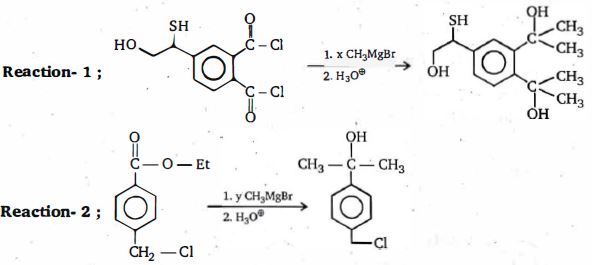
Product $(C)$ of the above reaction is
$\mathrm{Zn}\left|\mathrm{Zn}^{2+}(\mathrm{aq}),(1 \mathrm{M}) \| \mathrm{Fe}^{3+}(\mathrm{aq}), \mathrm{Fe}^{2+}(\mathrm{aq})\right| \mathrm{Pt}(\mathrm{s})$
The fraction of total iron present as $\mathrm{Fe}^{3+}$ ion at the cell potential of $1.500\, \mathrm{~V}$ is $\mathrm{X} \times 10^{-2}$. The value of $x$ is $.....$ (Nearest integer).
$\left(\right.$ Given $\left.E_{\mathrm{Fe}^{3+} / \mathrm{Fe}^{2+}}^{0}=0.77\, \mathrm{~V}, \mathrm{E}_{\mathrm{Zn}^{2+} / \mathrm{Zn}}^{0}=-0.76 \,\mathrm{~V}\right)$
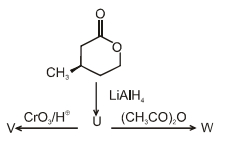
$(A)$ $T$ is soluble in hot aqueous $NaOH$
$(B)$ $U$ is optically active
$(C)$ Molecular formula of $W$ is $C _{10} H _{18} O _4$
$(D)$ $V$ gives effervescence on treatment with aqueous $NaHCO _3$