MCQ
When $CuS{O_4}$ is hydrated, then it becomes
  • A
    Acidic
  • B
    basic
  • C
    Neutral
  • Amphoteric

Answer

Correct option: D.
Amphoteric
d
It’s Obvious.

Need a full question paper?

Generate a complete, print-ready paper with questions like this in minutes — across 16+ boards, with answer keys.
Start Generating Free

Similar questions

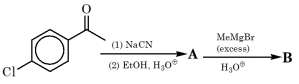
Find out the major products from the following reaction sequence.
Acid catalysed hydration of alkenes except ethene leads to the formation of.
The mass of glucose that should be dissolved in  $100\, g$ of water in order to produce  same  relative lowering of vapour pressure as is produced by dissolving $1\,g$ of urea  (mol.  Mass $= 60$) in $50\, g$ of water is  ........... $g$. (Assume dilute solution in both cases) :-
In the equation $4M + 8C{N^ - } + 2{H_2}O + {O_2} \to 4{[M{(CN)_2}]^ - } + 4O{H^ - }$ Identify the metal $M$
Equivalent weight of $H_3PO_2$ when it dispropertinate in to $PH_3$ and $H_3PO_3$ is
 
In a reaction, $n_1A + n_2B \to  m_1C + m_2D$ , $5\,M$ of reactant $A$ are allowed to react with $3\,M$ of reactant $B$. After $5\, second$, the concentration of $A$ was found to be $4\,M$. Rate of decomposition $A$ and rate of formation of $D$ respectively
The rate of reaction is determined by slow step reaction. The step is called
An ion of definite magnetic moment (spin only) is
The main reason for larger number of oxidation states exhibited by the actinoids than the corresponding lanthanoids is
Consider the cell whose $emf$ is $1.01\, V$.

$\mathop {{H_2}(Pt)}\limits_{1\,atm} \left| {\begin{array}{*{20}{c}}
{H_{aq}^ + }\\
{pH = 4}
\end{array}} \right|\left| {\begin{array}{*{20}{c}}
{A{g^ + }}\\
{xM}
\end{array}} \right|\begin{array}{*{20}{c}}
{Ag}\\
{}
\end{array}$

What is the value of $x$ ? ........... $\mathrm{M}$

( give : $E_{A{g^ + }|Ag}^o = + 0.8$   $\frac{{2.303\,RT}}{F} = 0.06 $)