Question
When do you describe the relationship between two organisms as mutualistic, competitive and parasitic? Give one example of each type.

Answer

Mutualistic: Both the interacting organisms are benefitted from each other e.g. Lichens- Algae and fungi mutually help each other or any other appropriate example.
Competition: When two organisms belonging to closely related species/unrelated groups compete for the same resources that are limiting both are losers, e.g. superior barnacle dominates and excludes the small barnacles/in some South American lakes visiting flamingoes and resident fishes compete for their common food (zooplankton) in the lake.
Parasitic: One of the two organisms is dependent on the other( host) for nutrition and support/the host is harmed and the parasite is benefitted. e.g. Malarial parasite and human/Cuscuta on host plant.

Need a full question paper?

Generate a complete, print-ready paper with questions like this in minutes — across 16+ boards, with answer keys.

Start Generating Free

Similar questions

Which one of the two in-situ or ex-situ biodiversity conservation measures help the larger number of species to survive? Explain.
List six advantages of ex-situ approach to conservation of biodiversity.
Write the name of 4 reproductive events of sexual reproduct that occur after attaining puberty in human.
  1. Mark the positive and negative terminals.
  2. What is the charge carried by DNA molecule and how does it help in its separation?
  3. How the separated DNA fragments are finally isolated?
Using a Punnett Square, workout the distribution of phenotypic features in the first filial generation after a cross between a homozygous female and a heterozygous male for a single locus.
Given below is a list of six micro-organisms. State their usefulness to humans.
  1. Nucleopolyhedrovirus.
  2. Saccharomyces cerevisiae.
  3. Monascus purpureus.
  4. Trichoderma polysporum.
  5. Penicillium notatum.
  6. Propionibacterium sharmanii.
Parthenocarpy does not involve fusion of gametes yet it leads to production of fruits. How?
How is the entry of only one sperm and not many ensured into an ovum during fertilisation in humans?
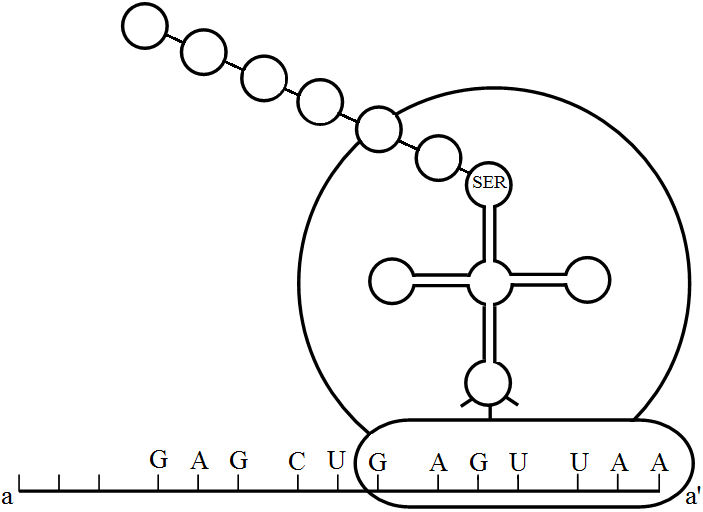
  1. Identify the polarity of strand in the diagram from a to a', and mention how many more amino acids can be expected to be added to this polypeptide chain.
  2. Mention the DNA sequence coding for serine and the anticodon of tRNA for the same amino acid.
  3. Why are some untranslated sequence of bases seen in mRNA coding for a polypeptide?
Where exactly are they present on mRNA?
Can you think and answer how a reporter enzyme can be used to monitor transformation of host cells by foreign DNA in addition to a selectable marker?