MCQ
When electron remains between orbits, its momentum is:
- AQuantized
- BDequantized
- CEmitted
- DChanged always
Explanation:
The first postulate of Bhor theory is that the orbital momentum of the electron is quantized ie, L = mvr = nh where h is Drac constant.
Generate a complete, print-ready paper with questions like this in minutes — across 16+ boards, with answer keys.
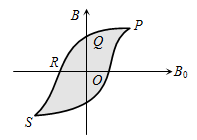
The figure illustrate how B, the flux density inside a sample of unmagnetised ferromagnetic material varies with B0, the magnetic flux density in which the sample is kept. For the sample to be suitable for making a permanent magnet
|
(a) OQ should be large, OR should be small |
|
(b) OQ and OR should both be large |
|
(c) OQ should be small and OR should be large |
|
(d) OQ and OR should both be small |
A thin convex lens of focal length 10 cm is placed in contact with a concave lens of same material and of same focal length. The focal length of combination will be
|
(a) Zero |
(b) Infinity |
(c) 10 cm |
(d) 20 cm |
Two point charges +9e and +e are at 16 cm away from each other. Where should another charge q be placed between them so that the system remains in equilibrium
|
(a) 24 cm from +9e |
(b) 12 cm from +9e |
(c) 24 cm from +e |
(d) 12 cm from +e |
The internal resistance of a primary cell is 4 ohm. It generates a current of 0.2 amp in an external resistance of 21 ohm. The rate at which chemical energy is consumed in providing the current is
|
(a) 0.42 J/s |
(b) 0.84 J/s |
(c) 5 J/s |
(d) 1 J/s |
The de-Broglie wavelength of an electron in the first Bohr orbit is
|
(a) Equal to one fourth the circumference of the first orbit |
|
(b) Equal to half the circumference of the first orbit |
|
(c) Equal to twice the circumference of the first orbit |
|
(d) Equal to the circumference of the first orbit |
$\text{W}_2=\text{W}_1$
$\text{W}_2=\text{W}_1+\omega$
$\text{W}_2<\text{W}_1+\omega$
$\text{W}_2>\text{W}_1$