MCQ
When $FeC{l_3}$ gets soluble in water, then its solution represents which of the characteristics
  • A
    Amphoteric
  • Acidic
  • C
    Basic
  • D
    Neutral

Answer

Correct option: B.
Acidic
(b)Hydrolysis of $F{e^{3 + }}$
$F{e^{3 + }} + 3{H_2}O \to Fe{(OH)_3} + 3{H^ + }$

Need a full question paper?

Generate a complete, print-ready paper with questions like this in minutes — across 16+ boards, with answer keys.

Start Generating Free

Similar questions

Which sequence of steps describes the best synthesis of $2-$ phenylpropene ?
$10\, mL$ of $2\,(M)\, NaOH$ solution is added to $200\, mL$ of $0.5\, (M)$ of $NaOH$ solution. What is the final concentration ?............. $\mathrm{M}$
Which of the following H -bond is strong at :
A buffer solution with $pH$$=9$ is to be prepared by mixing $N{H_4}Cl$ and $N{H_4}OH$. Calculate the number of moles of $N{H_4}Cl$ that should be added to one litre of $1.0\,M\;N{H_4}OH.\,$ $[{K_b} = 1.8 \times {10^{ - 5}}]$
Benzene $ + \,\begin{array}{*{20}{c}}
  {\begin{array}{*{20}{c}}
  {\,\,\,\,\,\,C{H_3}\,\,\,\,\,\,\,\,\,\,\,\,\,\,\,\,\,\,\,\,\,\,\,\,\,\,} \\ 
  {|\,\,\,\,\,\,\,\,\,\,\,\,\,\,\,\,\,\,\,\,\,\,\,\,\,} 
\end{array}\,\,\,\,} \\ 
  {C{H_3} - C - C{H_2} - Cl\xrightarrow{{AlC{l_3}}}} \\ 
  {|\,\,\,\,\,\,\,\,\,\,\,\,\,\,\,\,\,\,\,\,\,\,\,\,\,\,\,\,\,} \\ 
  {C{H_3}\,\,\,\,\,\,\,\,\,\,\,\,\,\,\,\,\,\,\,\,\,\,\,\,} 
\end{array}$  Major product
The correct order of ionisation energy is :
Match items of column $I$ and $II$

Column $I$ (Mixture of compounds) Column $II$ (Separation Technique)
$A$ $H _2 O / CH _2 Cl _2$ $I$ Crystallization
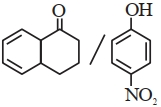
$B$ $Image$ $II$ Differential solvent extraction
$C$ Kerosene/Naphthalene $III$ Column chromatography
$D$ $C _6 H _{12} O _6 / NaCl$ $IV$ Fractional Distillation

Correct match is : 

Maximum number of electrons in a subshell with $l = 3$ and $n = 4$ is
The $pH$ of a solution at $25\,^oC$ containing $0.10\,m$ sodium acetate and $0.03\,m$ acetic acid is $(p{K_a}$ for $C{H_3}COOH = 4.57)$
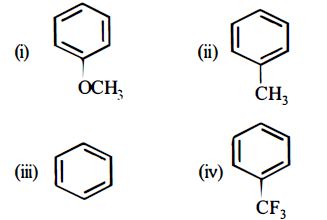
In the below mentioned compounds the decreasing order of reactivity towards electrophilic substitution is