Question
When hydrogen atom is in its first excited level, it’s radius is:

Answer

  1. Four times, it ground state radius.

Need a full question paper?

Generate a complete, print-ready paper with questions like this in minutes — across 16+ boards, with answer keys.
Start Generating Free

Similar questions

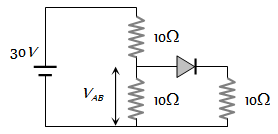
Find $V_{AB}$
In the formation of primary rainbow, the sunlight rays emerge at minimum deviation from rain-drop after(a) One internal reflection and one refraction(b) One internal reflection and two refractions(c) Two internal reflections and one refraction(d) Two internal reflections and two refractions


The explosion of the atomic bomb takes place due to(a) Nuclear fission(b) Nuclear fusion(c) Scattering(d) Thermionic emission
   
   
Which among the following can be used to analyze circuits?
A small lamp is hung at a height of $8$ feet above the centre of a round table of diameter $16$ feet. The ratio of intensities of illumination at the centre and at points on the circumference of the table will be
The colour of bright fringes nearest to the central achromatic fringe in the interference pattern with white light will be:
An electric bulb illuminates a plane surface. The intensity of illumination on the surface at a point $2 m$ away from the bulb is $5 \times 10^{-4}$ phot $($lumen$/cm^2)$. The line joining the bulb to the point makes an angle of $60^{\circ}$ with the normal to the surface. The intensity of the bulb in candela is
A particle moves in a region having a uniform magnetic field and a parallel, uniform electric field. At some instant, the velocity of the particle is perpendicular to the field direction. The path of the particle will be:
  1. A straight line.
  2. A circle.
  3. A helix with uniform pitch.
  4. A helix with nonuniform pitch.
The self-inductance of a long solenoid carrying current is independent of:
Minimum deviation is observed with a prism having angle of prism A, angle of deviation δ, angle of incidence i and angle of emergence e. We then have generally(a) i > e    (b) i < e(c) i = e    (d) i = e = δ