Question
When is a body lying in a gravitation field in stable equilibrium?

Answer

A body in a gravitation field will be in stable equilibrium, if the vertical line through its centre of gravity passes through the base of the body.

Need a full question paper?

Generate a complete, print-ready paper with questions like this in minutes — across 16+ boards, with answer keys.
Start Generating Free

Similar questions

In the given progressive wave $​​​​\text{y}=5\sin(100\pi\text{t+0.4x})$ where y and x are in m, t is in s. What is the:
Wave length
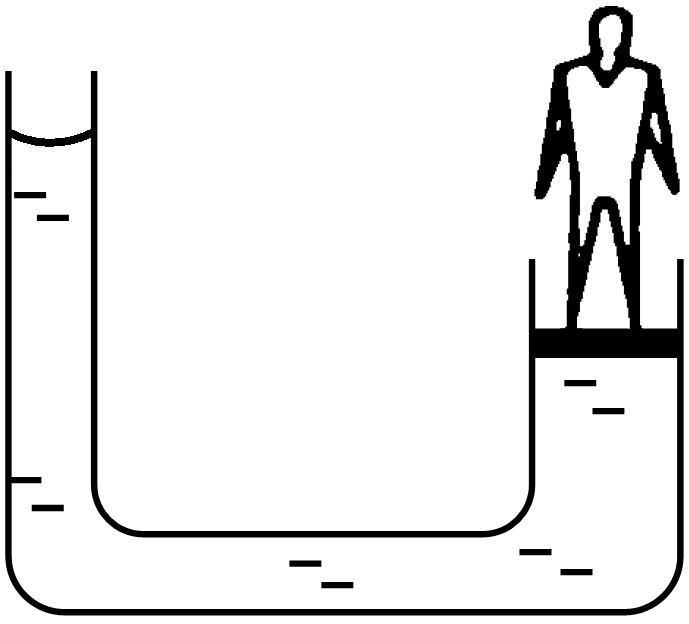
The area of cross-section of the wider tube shown in  is 900cm2. If the boy standing on the. Piston weighs 45kg, find the difference in the levels of water in the two tubes.

A spherical planet has mass Mp and diameter Dp. A particle of mass m falling freely near the surface of this planet will experience an acceleration due to gravity, equal to whom?
Does a body at 20°C radiate in a room, where the room temperature is 30°C? If yes, why does its temperature not fall further?
A passenger of mass 72.2kg is riding in an elevator while standing on a platform scale. What does the scale read when the elevator cab is:
  1. Descending with constant velocity,
  2. Ascending with constant acceleration, 3.5m/ s?
A Mars satellite moving in an orbit of radius 9.4 × 10³km takes 27540s to complete one revolution. Calculate the mass of Mars.
A source emits 31.4W of radiant flux distributed uniformly in all directions. The luminous efficiency is 60 lumen/ watt. What is the luminous intensity of the source?
Water flows at a speed of 6cm/ s through a tube of radius 1cm. Coefficient of viscosity of water at room temperature is 0.001 Poise. What is the nature of the flow?
The friction force of air on an object moving in air is directly proportional to the velocity of the object, what will be the dimension of constant of proportionality (b)?
The design of some physical instrument requires that there be a constant difference in length of 10cm between an iron rod and copper rod laid side by side at all temperatures. Find their lengths.
$\alpha_{\text{Fe}}=11\times10^{-6}\ ^\circ\text{C}^{-1},$
$\alpha_{\text{Cu}}=17\times10^{-6}\ ^\circ\text{C}^{-1}.$