MCQ
When lead nitrate is heated, it gives
- ✓$N{O_2}$
- B$NO$
- C${N_2}{O_5}$
- D${N_2}O$
$2Pb{(N{O_3})_2} \to 2PbO + 4N{O_2} + {O_2}$
So nitric oxide ${N_2}O$ is produced.
Generate a complete, print-ready paper with questions like this in minutes — across 16+ boards, with answer keys.
| List $-I$ | List $-II$ |
| $A$ $XeF_4$ | $1.$ Pyramidal |
| $B$ $XeF_6$ | $2.$ $T-$ shape |
| $C$ $XeO_3$ | $3.$ Distorted octahedral |
| $D$ $XeOF_2$ | $4.$ Square planar |
$H_2 + F_2 \longrightarrow 2HF$
given that
Bond energy of $H-H$ bond $= 434\, kJ/mol$
Bond energy of $F-F$ bond $= 158\, kJ/mol$
Bond energy of $H-F$ bond $= 565\, kJ/mol$
.....$ kJ$
$A + D \rightleftharpoons AD,AD + D \rightleftharpoons A{D_2}$, $A{D_2} + D \rightleftharpoons A{D_3}$. Then equilibrium constant $'K'$ for $A + 3D \rightleftharpoons A{D_3}$ is related as
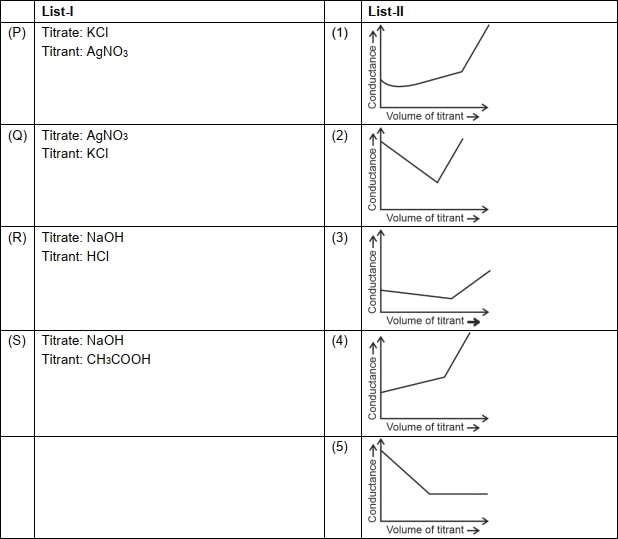
The limiting ionic conductivity ( $\Lambda 0$ ) values (in $mS m ^2 mol ^{-1}$ ) for different ions in aqueous solutions are given below:
| Ions | $Ag ^{+}$ | $K ^{+}$ | $Na ^{+}$ | $H ^{+}$ | $NO _3^{-}$ | $CI ^{-}$ | $SO _4^{2-}$ | $OH ^{-}$ | $CH_3COO ^{-}$ |
| $\Lambda_0$ | $6.2$ | $7.4$ | $5.0$ | $35.0$ | $7.2$ | $7.6$ | $16.0$ | $19.9$ | $4.1$ |
For different combinations of titrates and titrants given in $List-l$, the graphs of 'conductance' versus 'volume of titrant' are given in $List-II$.
Match each entry in $List-I$ with the appropriate entry in $List-II$ and choose the correct option.