MCQ
When light falls on matter, it can produce:
  • A
    Mechanical effect
  • B
    Chemical effect
  • C
    Heating effect
  • All the above

Answer

Correct option: D.
All the above

since photons have momentum and energy, they can produce all the three stated effects.

Need a full question paper?

Generate a complete, print-ready paper with questions like this in minutes — across 16+ boards, with answer keys.

Start Generating Free

Similar questions

Consider the following statements regarding the real images formed with a converging lens.

$I$. Real images can be seen only if the image is projected onto the screen.

$II$. The real image can be seen only from the same side of the lens as that on which the object is positioned.

$III$. Real images produced by converging lenses are not only laterally but also longitudinally inverted as with mirrors.

Which of the above statement(s) is/are incorrect?
A concave lens of focal length $f$ produces an image $(1 / x)$ of the size of the object. The distance of the object from the lens is .....
The time period of oscillation of a freely suspended bar magnet with usual notations is given by
The work function of a metal is $hv_0$. Light of frequency $v$ falls on this metal. The photoelectric effect will take place only if:
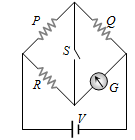
In the circuit shown P ≠ R, the reading of the galvanometer is same with switch S open or closed. Then

Which of the following processes represents a gamma-decay
Three observers $A, B$ and $C$ measure the speed of light coming from a source to be $vA, 0B$ and $vc.$ The observer $A$ moves towards the source and $C$ moves away from the source at the same speed. The observer $B$ stays stationary. The surrounding space is vacuum everywhere.
A wire of radius $r$ has resistance $R$. If it is stretched to a radius of $\frac{{3r}}{4}$, its resistance becomes
Which of the following cannot be polarised?
The slopes of anode and mutual characteristics of a triode are $0.02 \ mA\ V^{-1}$ and 1 mA $V^{-1}$ respectively. What is the amplification factor of the valve