Question
When light is incident on a diffraction grating the zero order principal maximum will be (a) One of the component  colours(b) Absent(c) Spectrum of the colours(d) White


Answer

(d) White

Need a full question paper?

Generate a complete, print-ready paper with questions like this in minutes — across 16+ boards, with answer keys.
Start Generating Free

Similar questions

A photon, an electron and a uranium nucleus all have the same wavelength. The one with the most energy(a) Is the photon(b) Is the electron(c) Is the uranium nucleus(d) Depends upon the wavelength and the properties of the particle.


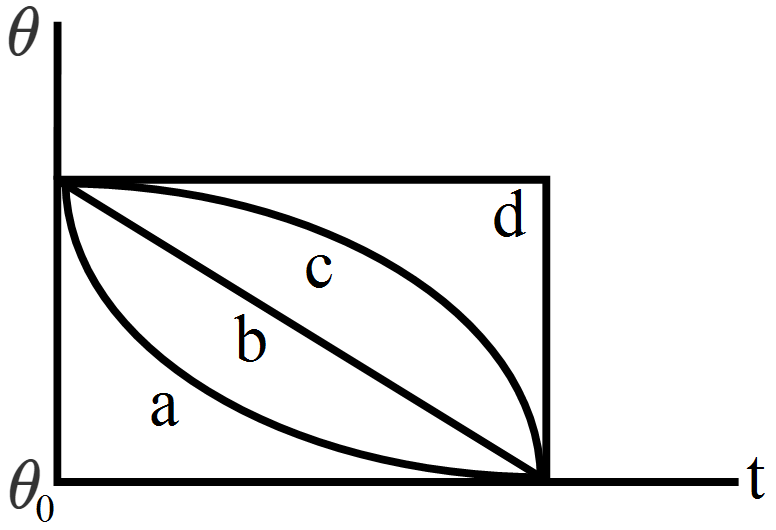
A hot liquid is kept in a big room. Its temperature is plotted as a function of time. Which of the following curves may represent the plot?
The SI unit of electric flux is:
For a substance the average life for a-emission is 1620 years and for b emission is 405 years. After how much time the 1/4 of the material remains after a and b emission(a) 1500 years(b) 300 years(c) 449 years(d) 810 years
       
The electric field due to an electric dipole at a distance r from its centre in axial position is E. If the dipole is rotated through an angle of 90° about its perpendicular axis, the electric field at the same point will be(a) E (b) E/4(c) E/2(d) 2E
       
Two identical thin rings each of radius $R$ meters are coaxially placed at a distance $R$ meters apart. If $Q_1$ coulomb and $Q_2$ coulomb are respectively the charges uniformly spread on the two rings, the work done in moving a charge qfrom the centre of one ring to that of other is
For non-conductors, the energy gap is(a) 6 eV  (b) 1.1 eV(c) 0.8 eV (d) 0.3 eV
       
C and Si both have the same lattice structure, having 4 bonding electrons in each. However, C is an insulator whereas Si is an intrinsic semiconductor. This is because
A. In case of C the valence band is not completely filled at absolute zero temperature.
B. In case of C the conduction band is partly filled even at absolute zero temperature.
C. The four bonding electrons in the case of C lie in the second orbit, whereas in the case of Si they lie in the third.
D. The four bonding electrons in the case of C lie in the third orbit, whereas for Si they lie in the fourth orbit.
In a PN-junction(a) P and N both are at same potential(b) High potential at N side and low potential at P side(c) High potential at P side and low potential at N side(d) Low potential at N side and zero potential at P side


Astigmatism (for a human eye) can be removed by using(a) Concave lens(b) Convex lens (c) Cylindrical lens(d) Prismatic lens