Question
When light is refracted, which of the following does not change?
  1. Wavelepgth.
  2. Frequency.
  3. Velocity.
  4. Amplitude.

Answer

  1. Frequency.

Explanation:

Frequency of a light wave doesnt change on changing the medium of propagation of light.

Need a full question paper?

Generate a complete, print-ready paper with questions like this in minutes — across 16+ boards, with answer keys.
Start Generating Free

Similar questions

A diatomic gas $(\gamma=1.4)$ does $400 J$ of work when it is expanded isobarically. The heat given to the gas in the process is ............ $J$
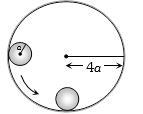
A ring of radius $4a$ is rigidly fixed in vertical position on a table. A small disc of mass $m$ and radius $a$ is released as shown in the fig. When the disc rolls down, without slipping, to the lowest point of the ring, then its speed will be
A plane is inclined at an angle of 30° with horizontal. The magnitude of component of a vector $\vec{\text{A}}=-10\hat{\text{k}}$ perpendicular to this plane is (here z-direction is vertically upwards):
Which of the following statements is/are not an assumption of the kinetic theory for an ideal gas?
When a horse pulls a cart, the force that helps the horse to move forward is the force exerted by:
  1. The cart on the horse.
  2. The ground on the horse.
  3. The ground on the cart.
  4. The horse on the ground.
The X-ray beam emerging from an X-ray tube:
  1. Is monochromatic.
  2. Has all wavelengths smaller than a certain maximum wavelength.
  3. Has all wavelengths greater than a certain minimum wavelength.
  4. Has all wavelengths lying between a minimum and a maximum wavelength.
The velocity with which a projectile must be fired so that it escapes earth’s gravitation does not depend on
Which graph represents the difference between total energy and potential energy of a particle executing $SHM$ Vs it's distance from mean position?
Electric field in a certain region is given by $\overrightarrow{ E }=\left(\frac{ A }{ x ^2} \hat{ i }+\frac{ B }{ y ^3} \hat{ j }\right)$. The $SI$ unit of $A$ and $B$ are
The area of cross section of a steel wire $(Y = 2.0 \times {10^{11}}N/{m^2})$ is $0.1\;c{m^2}$. The force required to double its length will be